Back to Integrations
integrationSlack node
integrationWhatsApp Business Cloud node

Slack and WhatsApp Business Cloud integration

Save yourself the work of writing custom integrations for Slack and WhatsApp Business Cloud and use n8n instead. Build adaptable and scalable Communication, and HITL workflows that work with your technology stack. All within a building experience you will love.

How to connect Slack and WhatsApp Business Cloud

  • Step 1: Create a new workflow
  • Step 2: Add and configure nodes
  • Step 3: Connect
  • Step 4: Customize and extend your integration
  • Step 5: Test and activate your workflow

Step 1: Create a new workflow and add the first step

In n8n, click the "Add workflow" button in the Workflows tab to create a new workflow. Add the starting point – a trigger on when your workflow should run: an app event, a schedule, a webhook call, another workflow, an AI chat, or a manual trigger. Sometimes, the HTTP Request node might already serve as your starting point.
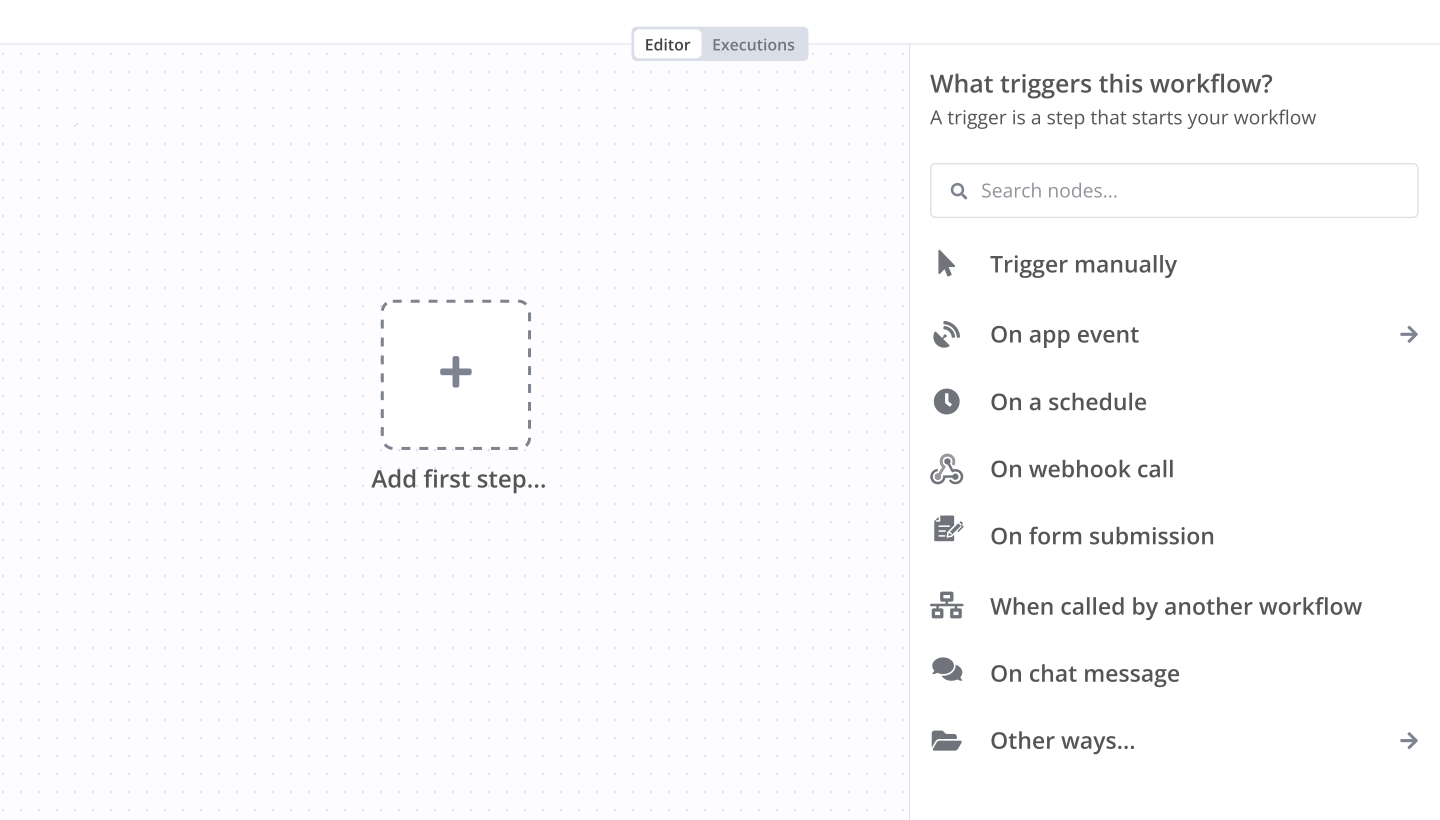
Slack and WhatsApp Business Cloud integration: Create a new workflow and add the first step

Step 2: Add and configure Slack and WhatsApp Business Cloud nodes

You can find Slack and WhatsApp Business Cloud in the nodes panel. Drag them onto your workflow canvas, selecting their actions. Click each node, choose a credential, and authenticate to grant n8n access. Configure Slack and WhatsApp Business Cloud nodes one by one: input data on the left, parameters in the middle, and output data on the right.

Slack and WhatsApp Business Cloud integration: Add and configure Slack and WhatsApp Business Cloud nodes

Step 3: Connect Slack and WhatsApp Business Cloud

A connection establishes a link between Slack and WhatsApp Business Cloud (or vice versa) to route data through the workflow. Data flows from the output of one node to the input of another. You can have single or multiple connections for each node.

Slack and WhatsApp Business Cloud integration: Connect Slack and WhatsApp Business Cloud

Step 4: Customize and extend your Slack and WhatsApp Business Cloud integration

Use n8n's core nodes such as If, Split Out, Merge, and others to transform and manipulate data. Write custom JavaScript or Python in the Code node and run it as a step in your workflow. Connect Slack and WhatsApp Business Cloud with any of n8n’s 1000+ integrations, and incorporate advanced AI logic into your workflows.

Slack and WhatsApp Business Cloud integration: Customize and extend your Slack and WhatsApp Business Cloud integration

Step 5: Test and activate your Slack and WhatsApp Business Cloud workflow

Save and run the workflow to see if everything works as expected. Based on your configuration, data should flow from Slack to WhatsApp Business Cloud or vice versa. Easily debug your workflow: you can check past executions to isolate and fix the mistake. Once you've tested everything, make sure to save your workflow and activate it.

Slack and WhatsApp Business Cloud integration: Test and activate your Slack and WhatsApp Business Cloud workflow

Summarize calls & notify teams via HubSpot, Slack, Email, WhatsApp

This workflow automates the process of handling conversation transcriptions and distributing key information across your organization. Here's what it does:

Trigger: The workflow is initiated via a webhook that receives a transcription (e.g., from a call or meeting).

Summarization & Extraction: Using AI, the transcription is summarized, and key information is extracted — such as action items, departments involved, and client details.

Department Notifications: The relevant summarized information is automatically routed to specific departments via email based on content classification.

CRM Sync: The summarized version is saved to the associated contact or deal in HubSpot for future reference and visibility.

*Multi-Channel Alerts: *The summary is also sent via WhatsApp and Slack to keep internal teams instantly informed, regardless of platform.

Use Case:
Ideal for sales, customer service, or operations teams who manage client conversations and want to ensure seamless cross-departmental communication, documentation, and follow-up.

Apps Used:

Webhook (Trigger)

OpenAI (or other AI/NLP for summarization)

HubSpot

Email

Slack

WhatsApp (via Twilio or third-party provider)

Nodes used in this workflow

Popular Slack and WhatsApp Business Cloud workflows

Summarize Calls & Notify Teams via HubSpot, Slack, Email, WhatsApp

This workflow automates the process of handling conversation transcriptions and distributing key information across your organization. Here's what it does: Trigger: The workflow is initiated via a webhook that receives a transcription (e.g., from a call or meeting). Summarization & Extraction: Using AI, the transcription is summarized, and key information is extracted — such as action items, departments involved, and client details. Department Notifications: The relevant summarized information is automatically routed to specific departments via email based on content classification. CRM Sync: The summarized version is saved to the associated contact or deal in HubSpot for future reference and visibility. *Multi-Channel Alerts: *The summary is also sent via WhatsApp and Slack to keep internal teams instantly informed, regardless of platform. Use Case: Ideal for sales, customer service, or operations teams who manage client conversations and want to ensure seamless cross-departmental communication, documentation, and follow-up. Apps Used: Webhook (Trigger) OpenAI (or other AI/NLP for summarization) HubSpot Email Slack WhatsApp (via Twilio or third-party provider)

Multi-Channel Workflow Error Alerts with Telegram, Gmail & Messaging Apps

The Error Notification workflow is designed to instantly notify you whenever any other n8n workflow encounters an error, using popular communication channels like Telegram and Gmail—with optional support for Discord, Slack, and WhatsApp. 💡 Why Use Error Notification workflow? Immediate Awareness:** Get instant alerts when workflows fail, preventing unnoticed errors and downtime. Multi-Channel Flexibility:** Notify your team via Telegram, Gmail, and optionally Slack, Discord, or WhatsApp. Detailed Context:** Receive rich error information including the error message, node name, time, and execution link for quicker fixes. Easy Integration:** Built with native n8n nodes and customizable code, simple to adopt without complex setup. Open Source & Free:** Use and adapt this workflow at no cost, making professional error monitoring accessible. ⚡ Who Is This For? n8n Workflow Developers:** Quickly spot and respond to automation issues in development or production. Operations Teams:** Maintain uptime and swiftly troubleshoot errors across multiple workflows. Small to Medium Businesses:** Gain professional error alerting without expensive monitoring tools. Automation Enthusiasts:** Enhance your automation reliability with real-time failure notifications. ❓ What Problem Does It Solve? This workflow embedd error detection and notification directly within your n8n instance. It automates the process of catching errors as they occur, compiling meaningful context, and delivering it instantly via your preferred messaging platforms. This drastically reduces your response time to issues and streamlines error management, improving your automation reliability and operational confidence. 🔧 What This Workflow Does ⏱ Trigger: Listens for any error generated in your n8n workflows using the n8n Error Trigger node. 📎 Step 2: Executes a Code node that formats a detailed error message capturing workflow name, error node, description, timestamp, and an execution URL. 🔍 Step 3: Sends the formatted error notification to multiple communication channels: Telegram and Gmail by default, plus optionally Discord, Slack, and WhatsApp (disabled by default). 💌 Step 4: Delivers rich, parsed HTML-formatted messages to ensure error readability and immediate actionability. 🔐 Setup Instructions Import the provided .json file into your n8n instance (Cloud or self-hosted). Set up credentials: Gmail OAuth credentials for sending emails via Gmail node Telegram API credentials for Telegram notifications (Optional) Discord Webhook URL credential for Discord notifications (Optional) Slack Webhook credential for Slack notifications (Optional) WhatsApp connection credentials (if enabled) Customize the Code node if needed to adjust the error message format or target chat IDs. Update the chat IDs and recipient details in each notification node according to your channels. Test the workflow by manually triggering an error in another workflow to verify proper notifications. 🧩 Pre-Requirements Active n8n instance (cloud or self-hosted) with version supporting Error Trigger node Telegram bot credentials and chat ID (Optional) Gmail, Discord, Slack, or WhatsApp accounts and webhook credentials if you want to use those channels 🛠️ Customize It Further Enable and configure additional notification nodes like Slack or WhatsApp to fit your team's communication style. Customize the error message template in the Code node to include extra metadata or format it differently (e.g., markdown). Integrate with incident management tools via webhook nodes or create tickets automatically on error. 🧠 Nodes Used Error Trigger Code Telegram Gmail Discord (disabled) Slack (disabled) WhatsApp (disabled) Sticky Note (for description) 📞 Support Made by: khaisa Studio Tag: notification,error,monitoring,workflow,automation,alerts Category: Monitoring & Alerts Need a custom? Need a custom? contact me on LinkedIn or Web
+4

Recover Shopify Abandoned Carts with Email, SMS, WhatsApp & Facebook Retargeting

This workflow is a complete, production-ready solution for recovering abandoned carts in Shopify stores using a multi-channel, multi-touch approach. It automates personalized follow-ups via Email, SMS, and WhatsApp, tracks every customer interaction for multi-touch attribution, and enables advanced retargeting and analytics. Key features: Multi-step, timed recovery sequence (Email → SMS → Email → WhatsApp) Customer segmentation (new, returning, VIP) and A/B testing Dynamic discounting and personalized messaging Touchpoint logging to Google Sheets for attribution analysis Facebook Custom Audience retargeting for unrecovered carts Slack notifications for high-value cart recoveries What does this workflow do? Listens for abandoned cart events from Shopify (or any e-commerce platform) via webhook. Normalizes and enriches cart data by fetching full cart details and customer purchase history. Predicts the likely reason for abandonment (e.g., price sensitivity, checkout complexity, technical issues) using rule-based logic. Segments the customer (new, returning, VIP), assigns an A/B test group, and generates a personalized discount and checkout URL. Runs a timed, multi-channel recovery sequence: 1 hour after abandonment: Checks if the order is completed. If not, sends a personalized Email #1 and logs the touchpoint. 4 hours after abandonment: Checks again. If not recovered, sends an SMS with a discount code and logs the touchpoint. 24 hours after abandonment: Checks again. If not recovered, sends Email #2 (with social proof/urgency) and logs the touchpoint. 48 hours after abandonment: Final check. If not recovered, sends a WhatsApp reminder and logs the touchpoint. If the cart is still not recovered: Hashes customer identifiers and adds them to a Facebook Custom Audience for retargeting. Logs every touchpoint (email, SMS, WhatsApp) to a Google Sheet for multi-touch attribution analysis. Sends a Slack notification if a high-value cart is recovered. Why is this workflow useful? Boosts recovery rates:** By using multiple channels and personalized timing, you maximize the chance of recovering lost sales. Improves attribution:** Every customer interaction is logged, so you can analyze which channels and messages drive conversions. Enables advanced retargeting:** Unrecovered carts are automatically added to a Facebook Custom Audience for paid retargeting. Saves time:** Fully automated, with easy configuration for your store, messaging, and analytics. Scalable and extensible:** Easily adapt the sequence, add more channels, or integrate with other tools. How to install and configure Prerequisites n8n instance (v2.0.2+ recommended) Shopify store with API access Accounts and API credentials for: SendGrid (email) Twilio (SMS) WhatsApp Business API Google Sheets (service account) Facebook Graph API (for Custom Audiences) Slack (for notifications) Setup steps Import the workflow into your n8n instance. Configure the “Workflow Configuration” node: Set your Shopify domain, API URLs, Google Sheets ID, and high-value threshold. Connect all required credentials in the respective nodes: Shopify, SendGrid, Twilio, WhatsApp, Google Sheets, Facebook Graph API, Slack. Create a Google Sheet named “Touchpoints” with columns: cart_id, customer_id, touchpoint_type, timestamp, channel, ab_group. Set up the webhook in your Shopify store (or e-commerce platform) to trigger the workflow on cart abandonment. Test the workflow with a sample abandoned cart event to ensure emails, SMS, WhatsApp, and logging work as expected. Enable the workflow in n8n for live operation. Node-by-node breakdown Abandoned Cart Webhook:** Receives abandoned cart events. Workflow Configuration:** Stores global settings (API URLs, Shopify domain, Google Sheets ID, high-value threshold). Normalize Cart Data:** Cleans and standardizes incoming cart data. Fetch Cart Details / Fetch Customer History:** Enriches data with full cart and customer info. Predict Abandonment Reason:** Uses business logic to guess why the cart was abandoned. Personalization Engine:** Segments the customer, assigns A/B group, calculates discount, and builds checkout URL. Customer Segment Check / Device Type Check:** Applies routing logic for personalized messaging. Wait / Check Order Status / Generate & Send Messages:** Timed sequence for Email, SMS, and WhatsApp, with order status checks at each step. Log Touchpoint (Google Sheets):** Records every message sent for attribution. Attribution Merge:** Combines all touchpoints into a single journey for analysis. Hash Customer Data for Facebook / Add to Retargeting Audience:** Adds unrecovered carts to a Facebook Custom Audience. Check Cart Value Threshold / Notify High-Value Recovery:** Sends Slack alerts for high-value recoveries. Customization tips Adjust wait times and message content to fit your brand and audience. Add or remove channels (e.g., push notifications, phone calls) as needed. Expand the Google Sheet for deeper analytics (e.g., add UTM parameters, campaign IDs). Integrate with your CRM or analytics platform for end-to-end tracking. Troubleshooting Make sure all API credentials are set and tested. Check Google Sheets permissions for the service account. Test each channel (email, SMS, WhatsApp) individually before going live. Review the workflow execution logs in n8n for errors or failed steps.

Manage WhatsApp Chats Centrally on Slack

This workflow enables seamless, bidirectional communication between WhatsApp and Slack using n8n. It automates the reception, processing, and forwarding of messages (text, media, and documents) between users on WhatsApp and private Slack channels. Key Features & Flow: WhatsApp to Slack Flow Trigger: The workflow starts with a WhatsApp Trigger node that listens for new incoming messages via a webhook. Channel Handling: It checks if a Slack channel with the WhatsApp sender’s number exists If not, it creates a private Slack channel with the sender's number as the name. Message Type Routing: A Switch Node (Message Type) inspects the message type (text, image, audio, document). Based on type: Text: Sends the message directly to Slack. Image/Audio/Document: Retrieves media URL via WhatsApp API → downloads the media → uploads it to the appropriate Slack channel. Slack to WhatsApp Flow Trigger: A Slack Trigger listens for new messages or file uploads in Slack. Message Type Routing: A second Switch Node (Checking Message Type) checks if the message is text or media. Routing Logic: Text Message: Extracts and forwards it to the WhatsApp contact (identified by the Slack channel name). Media/File Message: Retrieves media file URL from Slack → downloads it → sends it as a document via WhatsApp API. Key Integrations: WhatsApp Cloud API: For receiving messages, downloading media, and sending messages. Slack API: For creating/getting channels, posting messages, and uploading files. HTTP Request Node: Used to securely download media from Slack and WhatsApp servers with proper authentication. Automation Use Case: This workflow is ideal for businesses that handle customer support or conversations over WhatsApp and wish to log, respond, and collaborate using Slack as their internal communication tool.
+3

AI-Powered WhatsApp Customer Support for Shopify Brands with LLM Agents

🚀 AI-Powered WhatsApp Customer Support for Shopify Brands This n8n template builds a WhatsApp support copilot that answers **order status* and product availability* from Shopify using LLM "agents," then replies to the customer in WhatsApp or routes to human support. Use cases "Where is my order?" → live status + tracking link "What are your best-selling T-shirts?" → in-stock sizes & variants Greetings / small talk → welcome message Anything unclear → handoff to support channel Good to know WhatsApp Business conversations are billed by Meta/Twilio/Exotel; plan accordingly. Shopify Admin API has rate limits (leaky bucket) --- stagger requests. LLM usage incurs token costs; cap max tokens and enable caching where possible. Avoid sending PII to the model; only pass minimal order/product fields. How it works WhatsApp Trigger\ Receives an incoming message (e.g., "Where is my order?"). Get Customer from Shopify → Customer Details → Normalize Input\ Looks up the customer by phone, formats the query (lower-case, emoji & punctuation normalization). Switch (intent router)\ Classifies into welcome, orderStatusQuery, productQuery, or supportQuery. Welcome path\ Welcome message → polite greeting → (noop placeholder). Order status path (Orders Agent) Orders Agent (LLM + Memory) interprets the user request and extracts needed fields. Get Customer Orders (HTTP to Shopify) fetches the user's latest order(s). Structured Output Parser cleans the agent's output into a strict schema. Send Order Status (WhatsApp message) returns status, ETA, and tracking link. Products path (Products Agent) Products Agent (LLM + Memory) turns the ask into a product query. Get Products from Shopify (HTTP) pulls best sellers / inventory & sizes. Structured Output Parser formats name, price, sizes, stock. Send Products message (WhatsApp) sends a tidy, human-readable reply Support path Send a message to support posts the transcript/context to your agent/helpdesk channel and informs the user a human will respond How to use Replace the manual/WhatsApp trigger with your live WhatsApp number/webhook. Set env vars/credentials: Shopify domain + Admin API token, WhatsApp provider keys, LLM key (OpenAI/OpenRouter), and (optionally) your support channel webhook. Edit message templates for tone, add your brand name, and localize if needed. Test with samples: "Where is my order?", "Show best sellers", "Hi". Requirements WhatsApp Business API (Meta/Twilio/Exotel) Shopify store + Admin API access LLM provider (OpenAI/OpenRouter etc.) Slack webhook for human handoff Prerequisites Active WhatsApp Business Account connected via API provider (Meta, Twilio, or Exotel). Shopify Admin API credentials** (API key, secret, store domain). Slack OAuth app** or webhook for human support escalation. API key for your LLM provider (OpenAI, OpenRouter, etc.). Customising this workflow Add intents: returns/exchanges, COD confirmation, address changes. Enrich product replies with images, price ranges, and "Buy" deep links. Add multilingual support by detecting locale and templating responses. Log all interactions to a DB/Sheet for analytics and quality review. Guardrails: confidence thresholds → fallback to support; redact PII; retry on API errors.
+5

Capture, qualify, and route real estate leads with WhatsApp, Typeform, Airtable, Slack, Gmail, and GPT-4.1-mini

📌 Overview This n8n-powered workflow automates the entire lifecycle of real estate lead intake, qualification, routing, assignment, and reporting across multiple channels. It brings WhatsApp inquiries and website form submissions into a single intelligent system, where leads are processed conversationally using AI, deduplicated, normalized, assigned fairly to agents, logged into a centralized CRM, and reported on weekly. Designed specifically for real estate agencies, brokerages, and property teams, this system replaces manual follow-ups, spreadsheet chaos, and uneven agent assignments with a scalable, modular automation that can grow to include Facebook Lead Ads and Google Lead Forms without breaking downstream logic. 🧠 What It Does This workflow automates the full real estate lead pipeline. It: Collects inbound leads from WhatsApp and website forms. Uses AI to extract, validate, and structure lead information. Normalizes all leads into a consistent schema across sources. Detects and prevents duplicate leads (both within-run and CRM-level). Routes leads intelligently based on property interest. Assigns leads fairly using round-robin agent logic. Stores all leads and assignments in a centralized CRM. Sends automated notifications to agents and internal teams. Generates weekly lead, duplicate, and assignment reports. Is designed to be easily extended to Facebook Lead Ads and Google Lead Forms. 💡 Why This Workflow Real estate teams don’t struggle with demand — they struggle with lead management. This workflow was built to solve common real estate problems: Leads lost in WhatsApp chats Duplicate inquiries wasting agent time Uneven lead distribution across agents Manual CRM updates No visibility into weekly lead performance Instead of patching tools together, this workflow provides a single automated system that is reliable, extensible, and client-ready. 👤 Who It’s For This workflow is ideal for: Real estate agencies managing high WhatsApp and form lead inquiry volume Brokerages with multiple agents needing fair lead assignment Property developers handling inbound marketing leads Real estate lead generation teams Automation freelancers building reusable real estate systems ⚙️ How It Works 🧩 1. Lead Intake Workflow 🎯 Purpose Collect inbound leads from multiple channels and normalize them into a unified structure. 🛠 How It Works WhatsApp & Website Triggers Leads enter the system via: WhatsApp messages Website inquiry forms Lead Normalization Regardless of source, all leads are transformed into a common structure: First name, Last name, Phone number, Email, What is your budget range?, and others This ensures new channels (Facebook Lead Ads, Google Lead Forms) can be added later without changing core logic. 🧩 2. AI Lead Processing Workflow 🎯 Purpose Convert unstructured messages into clean, usable lead data. 🛠 How It Works AI Conversation Handling An AI agent processes inbound messages to: Extract missing details Validate lead intent Standardize property interest categories Data Validation Ensures required fields exist before moving forward. 🧩 3. Deduplication Workflow 🎯 Purpose Prevent duplicate leads from entering the system or being reassigned. 🛠 How It Works In-Execution Duplicate Check Prevents the same lead from being processed twice in a single run. CRM-Level Duplicate Detection Checks existing records using: Phone number Email Duplicate leads are flagged and excluded from reassignment while still logged for reporting. 🧩 4. Lead Routing & Agent Assignment Workflow 🎯 Purpose Assign leads fairly and intelligently to agents. 🛠 How It Works Property-Based Routing Leads are routed based on property type (e.g. Single-Family, Multi-Family, Condo). Round-Robin Assignment Agents are rotated automatically to ensure: Fair distribution No manual favoritism Predictable assignment logic 🧩 5. CRM Storage & Notifications Workflow 🎯 Purpose Keep all lead data centralized and notify the right people instantly. 🛠 How It Works CRM Logging (Airtable) Stores: Lead details** Assigned agent Source Deduplicates (Separate table) Timestamps Automated Notifications Sends alerts via: Email Slack So agents can respond immediately. 🧩 6. Weekly Reporting Workflow 🎯 Purpose Provide visibility into lead performance and system health. 🛠 How It Works Runs on a weekly schedule Generates summaries for: Total leads Duplicate leads Agent assignments Can be separated into its own workflow for scalability and reuse. 🛠 How to Set It Up Import the .json file into your n8n instance. Connect the required credentials: WhatsApp Trigger (Auth Connection) WhatsApp Business Cloud (Access Token) OpenAI API Key Airtable API Key (Access Token) Gmail Slack API Key (Access Token) Configure your data sources: Update the Airtable base and table names to match your CRM structure Real Estate Qualifier column names: First name | Last name | Phone number | Email | Location | Property Type | Timeframe | Payment Source | Pre Approved | Has Agent (Yes, No) | Lead (New, Contacted, Follow-up, Converted, Couldn't Convert) | Source | Assigned Agent | Assigned Time | Qualified (Yes, No) | Transcript | Summary Real Estate Qualifier Duplicate column names: First name | Last name | Phone number | Email | Location | Property Type | Timeframe | Payment Source | Pre Approved | Has Agent (Yes, No) | Source Customize business logic: Update agent pools and routing rules Adjust AI prompts if needed Review deduplication and reporting settings Activate the workflow: Click Publish to activate the workflow Send a test lead via WhatsApp or website form to confirm everything works 🎨 Customization Tips Add More Channels**: Plug in Facebook Lead Ads or Google Lead Forms — no restructuring needed. Routing Logic**: Customize routing by location, budget, or property category. CRM Expansion**: Add more fields (Notes, Follow-Up Status, Deal Stage). Reporting**: Extend weekly reports or connect to BI tools. Ads Integration**: Leads can optionally be passed into Facebook or Google Ads workflows after normalization. 📬 Contact For Enquiries: [email protected] Thank you for exploring this workflow!

Build your own Slack and WhatsApp Business Cloud integration

Create custom Slack and WhatsApp Business Cloud workflows by choosing triggers and actions. Nodes come with global operations and settings, as well as app-specific parameters that can be configured. You can also use the HTTP Request node to query data from any app or service with a REST API.

Slack supported actions

Archive
Archives a conversation
Close
Closes a direct message or multi-person direct message
Create
Initiates a public or private channel-based conversation
Get
Get information about a channel
Get Many
Get many channels in a Slack team
History
Get a conversation's history of messages and events
Invite
Invite a user to a channel
Join
Joins an existing conversation
Kick
Removes a user from a channel
Leave
Leaves a conversation
Member
List members of a conversation
Open
Opens or resumes a direct message or multi-person direct message
Rename
Renames a conversation
Replies
Get a thread of messages posted to a channel
Set Purpose
Sets the purpose for a conversation
Set Topic
Sets the topic for a conversation
Unarchive
Unarchives a conversation
Get
Get Many
Get & filters team files
Upload
Create or upload an existing file
Delete
Get Permalink
Search
Send
Send and Wait for Response
Update
Add
Adds a reaction to a message
Get
Get the reactions of a message
Remove
Remove a reaction of a message
Add
Add a star to an item
Delete
Delete a star from an item
Get Many
Get many stars of autenticated user
Get
Get information about a user
Get Many
Get a list of many users
Get User's Profile
Get a user's profile
Get User's Status
Get online status of a user
Update User's Profile
Update a user's profile
Add Users
Create
Disable
Enable
Get Many
Get Users
Update

WhatsApp Business Cloud supported actions

Send
Send and Wait for Response
Send Template
Upload
Download
Delete

FAQs

  • Can Slack connect with WhatsApp Business Cloud?

  • Can I use Slack’s API with n8n?

  • Can I use WhatsApp Business Cloud’s API with n8n?

  • Is n8n secure for integrating Slack and WhatsApp Business Cloud?

  • How to get started with Slack and WhatsApp Business Cloud integration in n8n.io?

Need help setting up your Slack and WhatsApp Business Cloud integration?

Discover our latest community's recommendations and join the discussions about Slack and WhatsApp Business Cloud integration.
Nicolas N
Muhammed Iqbal P B
Nicolas N

Looking to integrate Slack and WhatsApp Business Cloud in your company?

Over 3000 companies switch to n8n every single week

Why use n8n to integrate Slack with WhatsApp Business Cloud

Build complex workflows, really fast
Build complex workflows, really fast

Handle branching, merging and iteration easily.
Pause your workflow to wait for external events.

Code when you need it, UI when you don't

Simple debugging

Your data is displayed alongside your settings, making edge cases easy to track down.

Use templates to get started fast

Use 1000+ workflow templates available from our core team and our community.

Reuse your work

Copy and paste, easily import and export workflows.

Implement complex processes faster with n8n

red iconyellow iconred iconyellow icon