
Back to Integrations
integrationSupabase node
integrationWhatsApp Business Cloud node

Supabase and WhatsApp Business Cloud integration

Save yourself the work of writing custom integrations for Supabase and WhatsApp Business Cloud and use n8n instead. Build adaptable and scalable Data & Storage, Communication, and HITL workflows that work with your technology stack. All within a building experience you will love.

How to connect Supabase and WhatsApp Business Cloud

  • Step 1: Create a new workflow
  • Step 2: Add and configure nodes
  • Step 3: Connect
  • Step 4: Customize and extend your integration
  • Step 5: Test and activate your workflow

Step 1: Create a new workflow and add the first step

In n8n, click the "Add workflow" button in the Workflows tab to create a new workflow. Add the starting point – a trigger on when your workflow should run: an app event, a schedule, a webhook call, another workflow, an AI chat, or a manual trigger. Sometimes, the HTTP Request node might already serve as your starting point.
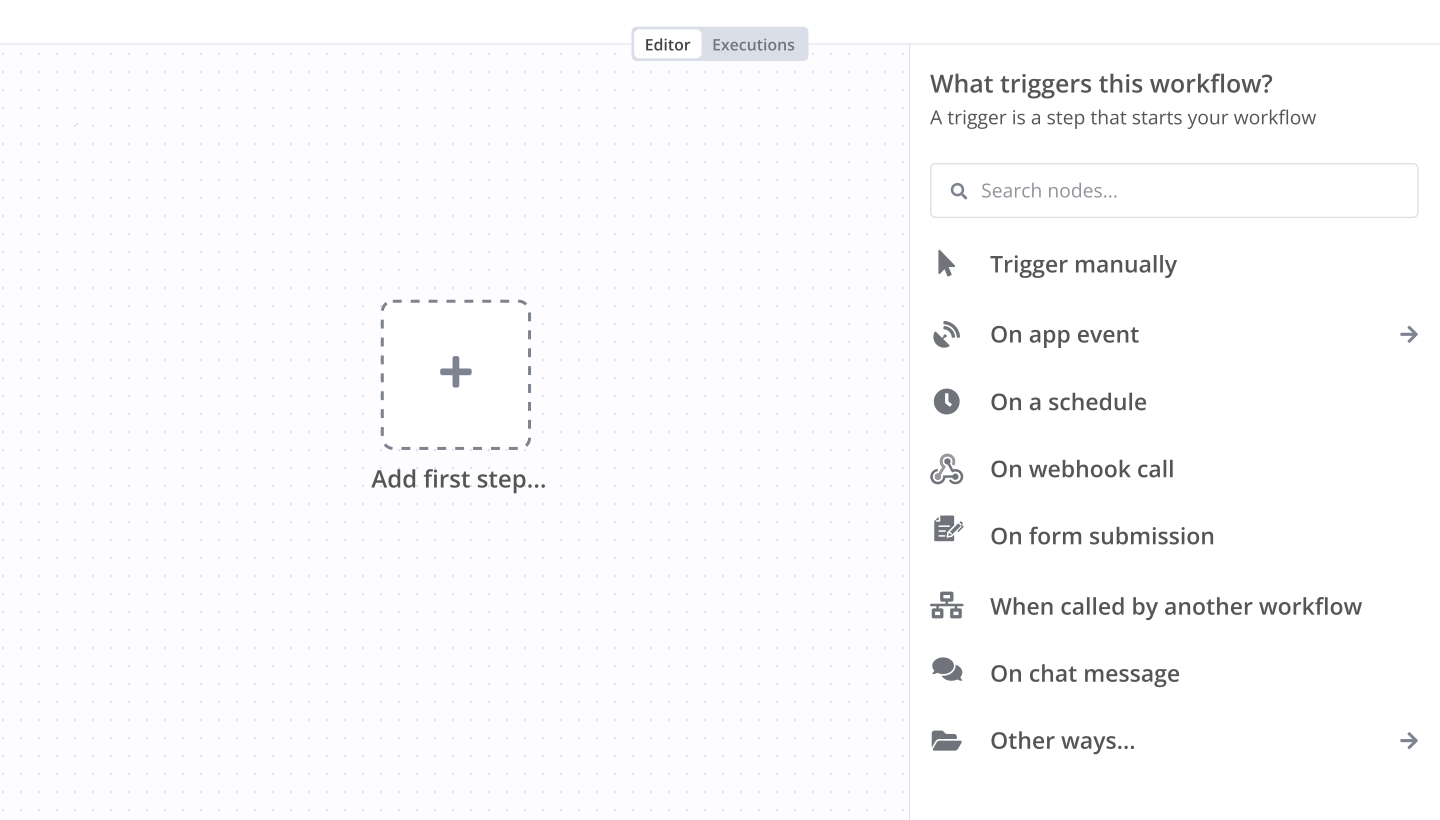
Supabase and WhatsApp Business Cloud integration: Create a new workflow and add the first step

Step 2: Add and configure Supabase and WhatsApp Business Cloud nodes

You can find Supabase and WhatsApp Business Cloud in the nodes panel. Drag them onto your workflow canvas, selecting their actions. Click each node, choose a credential, and authenticate to grant n8n access. Configure Supabase and WhatsApp Business Cloud nodes one by one: input data on the left, parameters in the middle, and output data on the right.

Supabase and WhatsApp Business Cloud integration: Add and configure Supabase and WhatsApp Business Cloud nodes

Step 3: Connect Supabase and WhatsApp Business Cloud

A connection establishes a link between Supabase and WhatsApp Business Cloud (or vice versa) to route data through the workflow. Data flows from the output of one node to the input of another. You can have single or multiple connections for each node.

Supabase and WhatsApp Business Cloud integration: Connect Supabase and WhatsApp Business Cloud

Step 4: Customize and extend your Supabase and WhatsApp Business Cloud integration

Use n8n's core nodes such as If, Split Out, Merge, and others to transform and manipulate data. Write custom JavaScript or Python in the Code node and run it as a step in your workflow. Connect Supabase and WhatsApp Business Cloud with any of n8n’s 1000+ integrations, and incorporate advanced AI logic into your workflows.

Supabase and WhatsApp Business Cloud integration: Customize and extend your Supabase and WhatsApp Business Cloud integration

Step 5: Test and activate your Supabase and WhatsApp Business Cloud workflow

Save and run the workflow to see if everything works as expected. Based on your configuration, data should flow from Supabase to WhatsApp Business Cloud or vice versa. Easily debug your workflow: you can check past executions to isolate and fix the mistake. Once you've tested everything, make sure to save your workflow and activate it.

Supabase and WhatsApp Business Cloud integration: Test and activate your Supabase and WhatsApp Business Cloud workflow

Classify lead sentiment with Google Gemini and send WhatsApp responses via Typeform & Supabase

Automatically classify incoming leads based on the sentiment of their message using Google Gemini, store them in Supabase by category, and send tailored WhatsApp messages via the official WhatsApp Cloud API.

✅ Use Case:
This workflow is ideal for sales, onboarding, and customer support teams who want to:

Understand the tone and urgency of each lead

Prioritize hot leads instantly

Send smart, automatic WhatsApp replies based on user sentiment

🧠 How it works:
Capture lead via a Typeform webhook

Clean and structure the data (name, email, message, etc.)

Run sentiment analysis using Google Gemini to classify the message as:

Positive → Hot Lead

Neutral → Warm Lead

Negative → Cold Lead

Store lead data in Supabase under the corresponding category

Merge data to unify flow paths

Send WhatsApp message using the official WhatsApp Cloud API, with a custom reply for each sentiment result

🔧 Tools used:
Typeform (incoming data)

Google Gemini (AI-based sentiment classification)

Supabase (database)

WhatsApp Cloud API (response automation)

🏷 Tags:
AI, Sentiment Analysis, Lead Qualification, Supabase, WhatsApp, Gemini, Typeform, CRM, Automation, Customer Engagement

Nodes used in this workflow

Popular Supabase and WhatsApp Business Cloud workflows

+4

AI-Powered Restaurant Order and Menu Management with WhatsApp and Google Gemini

RestaurantBot Pro - WhatsApp Order Automation System Description RestaurantBot Pro is a complete AI-powered restaurant ordering system that transforms your WhatsApp into a smart ordering platform. This intelligent automation handles customer interactions in any language you configure, manages your menu database, processes orders, and coordinates delivery operations - all through familiar WhatsApp messaging. How It Works Customer Experience: Customers message your restaurant's WhatsApp number in their preferred language The AI assistant greets them and presents your current menu with prices Customers can ask questions about items, place orders, and specify delivery details The system remembers customer preferences and order history for personalized service Customers receive instant confirmation and order updates Restaurant Operations: All orders are automatically saved to your database with customer details The system generates formatted messages for your delivery team with all order specifics Menu items are stored using advanced AI search, making it easy to find and recommend dishes Customer database grows automatically, tracking preferences and order history Real-time order processing with preparation time estimates Smart Features: Understands natural language ordering in any language (easily customizable in system settings) Intelligent menu recommendations based on customer queries Automatic price calculations and order summaries Memory system that recalls customer preferences across conversations Seamless integration between customer orders and delivery coordination Fully customizable language support - simply modify the AI agent's system instructions to serve customers in Arabic, English, French, Spanish, or any language of your choice Setup Steps Database Preparation Set up your restaurant database with customer and order tables Configure AI-powered menu search capabilities Enable vector extensions for intelligent menu recommendations WhatsApp Integration Connect your business WhatsApp account Configure webhook endpoints for message handling Set up automated responses and delivery notifications AI Configuration Connect Google Gemini AI models for natural language processing Customize language settings by editing the AI agent's system instructions to match your target audience Set up structured order processing and validation Menu Management Add your menu items through the admin interface Include prices, descriptions, categories, and preparation times Enable intelligent search and recommendations Delivery Setup : just add delevery phone number to the "Send Order to delevery" node Perfect for: Restaurants serving any cuisine and customer base - whether you need Arabic, English, French, Spanish, or any other language support. Simply adjust the AI agent's language settings to match your customers' preferences. Ideal for traditional ethnic restaurants, international chains, local eateries, delivery-focused establishments, and any restaurant wanting to modernize their ordering process while maintaining authentic customer communication in their preferred language.

Classify Lead Sentiment with Google Gemini and Send WhatsApp Responses via Typeform & Supabase

Automatically classify incoming leads based on the sentiment of their message using Google Gemini, store them in Supabase by category, and send tailored WhatsApp messages via the official WhatsApp Cloud API. ✅ Use Case: This workflow is ideal for sales, onboarding, and customer support teams who want to: Understand the tone and urgency of each lead Prioritize hot leads instantly Send smart, automatic WhatsApp replies based on user sentiment 🧠 How it works: Capture lead via a Typeform webhook Clean and structure the data (name, email, message, etc.) Run sentiment analysis using Google Gemini to classify the message as: Positive → Hot Lead Neutral → Warm Lead Negative → Cold Lead Store lead data in Supabase under the corresponding category Merge data to unify flow paths Send WhatsApp message using the official WhatsApp Cloud API, with a custom reply for each sentiment result 🔧 Tools used: Typeform (incoming data) Google Gemini (AI-based sentiment classification) Supabase (database) WhatsApp Cloud API (response automation) 🏷 Tags: AI, Sentiment Analysis, Lead Qualification, Supabase, WhatsApp, Gemini, Typeform, CRM, Automation, Customer Engagement

Create a Two-Way WhatsApp + Telegram Integration for 10k+ Customer Support Chats

⚡ Next-Gen Customer Support: Two-Way WhatsApp + Telegram Integration for 10k+ Clients Who is this workflow for This workflow is designed for **customer support teams, e-commerce founders, and operations managers** who want to handle thousands of customer queries seamlessly. Instead of building a brand-new chat application, it leverages WhatsApp (where customers already are) and Telegram (where your support team operates) to create a scalable, topic-based support system. If you are a brand handling 1000s of daily WhatsApp customer messages and need a structured way to map each customer into a dedicated support thread without chaos, this workflow is for you. What it does / How it works This two-way n8n automation bridges WhatsApp and Telegram by creating one Telegram forum topic per customer and syncing messages both ways: Incoming WhatsApp → Telegram When a new WhatsApp message arrives, the workflow checks if the customer already has a topic in Telegram. If yes → The message is forwarded into that existing topic. If no → A new topic is created automatically, the mapping is saved in the database, and the message is posted there. Result: every customer has a dedicated thread in your Telegram supergroup. Outgoing Telegram → WhatsApp When a support agent replies in a Telegram topic, the workflow looks up the linked WhatsApp number. The reply is sent back to the customer on WhatsApp, preserving context. Result: two-way synced conversations without building a custom app. How to set it up Configure WhatsApp Cloud API Create a Meta Developer account and register a WhatsApp Business number. Generate an access token and phone number ID. Configure Telegram Bot Use BotFather to create a bot and enable it in a **Telegram Supergroup with Topics**. Get the chat_id and allow the bot to create/send messages in topics. Database (Supabase/Postgres) Create a table wa_tg_threads to map phone_e164 ↔ telegram_topic_id ↔ supergroup_id. n8n Workflows Workflow A: WhatsApp → Telegram Trigger: WhatsApp Webhook Steps: Lookup customer → If exists send to topic, else create topic → Save mapping → Forward message. Workflow B: Telegram → WhatsApp Trigger: Telegram Webhook Steps: Filter only topic replies → Lookup mapping → Send WhatsApp message. Testing Send a WhatsApp message → Check Telegram topic created. Reply in Telegram topic → Ensure customer receives WhatsApp reply. Requirements A free or paid n8n instance (self-hosted or cloud). WhatsApp Cloud API credentials** (phone number ID + access token). Telegram Bot token* with access to a Supergroup with Topics* enabled. A Postgres/Supabase database to store thread mappings. Basic familiarity with editing HTTP Request nodes in n8n. How to customize the workflow Brand personalization:** Pre-populate first message templates (thank you, order status, delivery updates). Routing rules:** Assign specific agents to certain topics by ID ranges. Integrations:** Extend to CRMs (HubSpot, Zoho) or support platforms (Freshdesk, Zendesk). Notifications:** Push high-priority WhatsApp queries into Slack/Teams for instant alerts. Archival:** Auto-close inactive topics after N days and mark customers as dormant. Why Telegram instead of building a new App The client's requirement was clear: **use an existing, reliable, and scalable chat platform** instead of building a new app from scratch. Telegram Supergroups with Topics** scale to 100,000+ members and millions of messages, making them ideal for managing 10k+ customer threads. Agents don't need to install or learn a new tool---they continue inside Telegram, which is fast, free, and mobile-friendly. Building a custom chat app would require authentication, push notifications, scaling infra, and UX---all solved instantly by Telegram. This decision **saves development cost, accelerates deployment, and provides proven scalability**. Why this improves support productivity Organized by customer:** Each WhatsApp number has its own Telegram topic. No missed messages:** Agents can quickly scroll topics without drowning in one endless chat. Two-way sync:** Replies flow back to WhatsApp seamlessly. Scales automatically:** Handle 10k+ conversations without losing track. Leverages existing tools:** WhatsApp (customers) + Telegram (agents). Result: **faster responses, better tracking, and zero need to reinvent chat software.**
+2

Build a Knowledge-Based WhatsApp Assistant with RAG, Gemini, Supabase & Google Docs

Workflow Execution Link: Watch Execution Video Workflow Pre-requisites Step 1: Supabase Setup First, replace the keys in the "Save the embedding in DB" & "Search Embeddings" nodes with your new Supabase keys. After that, run the following code snippets in your Supabase SQL editor: Create the table to store chunks and embeddings: CREATE TABLE public."RAG" ( id bigserial PRIMARY KEY, chunk text NULL, embeddings vector(1024) NULL ) TABLESPACE pg_default; Create a function to match embeddings: DROP FUNCTION IF EXISTS public.matchembeddings1(integer, vector); CREATE OR REPLACE FUNCTION public.matchembeddings1( match_count integer, query_embedding vector ) RETURNS TABLE ( chunk text, similarity float ) LANGUAGE plpgsql AS $$ BEGIN RETURN QUERY SELECT R.chunk, 1 - (R.embeddings <=> query_embedding) AS similarity FROM public."RAG" AS R ORDER BY R.embeddings <=> query_embedding LIMIT match_count; END; $$; Step 2: Create Knowledge Base Create a new Google Doc with the complete knowledge base about your business and replace the document ID in the "Content for the Training" node. Step 3: Get Together AI API Key Get a Together AI API key and paste it into the "Embedding Uploaded document" node and the "Embed User Message" node. Step 4: Setup Meta App for WhatsApp Business Cloud Go to https://business.facebook.com/latest/settings/apps, create an app, and select the use case "Connect with customer through WhatsApp". Copy the Client ID and Client Secret and add them to the first node. Go to that newly created META app in the app dashboard, click on the use case, and then click on "customise...". Go to the API setup, add your number, and also generate an access token on that page. Now paste the access token and the WhatsApp Business Account ID into the send message node. Part A: Document Preparation (One-Time Setup) When clicking ‘Execute workflow’ Type:** manualTrigger Purpose:** Manually starts the workflow for preparing training content. Content for the Training Type:** googleDocs Purpose:** Fetches the document content that will be used for training. Splitting into Chunks Type:** code Purpose:** Breaks the document text into smaller pieces for processing. Embedding Uploaded document Type:** httpRequest Purpose:** Converts each chunk into embeddings via an external API. Save the embedding in DB Type:** supabase Purpose:** Stores both the chunks and embeddings in the database for future use. Part B: Chat Interaction (Realtime Flow) WhatsApp Trigger Type:** whatsAppTrigger Purpose:** Starts the workflow whenever a user sends a WhatsApp message. If Type:** if Purpose:** Checks whether the incoming WhatsApp message contains text. Embend User Message Type:** httpRequest Purpose:** Converts the user’s message into an embedding. Search Embeddings Type:** httpRequest Purpose:** Finds the top matching document chunks from the database using embeddings. Aggregate Type:** aggregate Purpose:** Merges retrieved chunks into one context block. AI Agent Type:** langchain agent Purpose:** Builds the prompt combining user’s message and context. Google Gemini Chat Model Type:** lmChatGoogleGemini Purpose:** Generates the AI response based on the prepared prompt. Send message Type:** whatsApp Purpose:** Sends the AI’s reply back to the user on WhatsApp.
+7

AI-Powered WhatsApp Customer Service with GPT-4, Smart Routing & Knowledge Base

AI-Powered Customer Service Automation with Smart Routing How it works Core Intelligence Pipeline • Multi-Layer Message Analysis - Every customer interaction passes through three specialized AI classifiers: privacy detection (identifies sensitive data and security requirements), intent recognition (categorizes requests as purchases, inquiries, complaints, technical support, or order tracking), and sentiment analysis (monitors emotional tone from neutral to critical frustration levels) • Dynamic Knowledge Integration - The system maintains live connections to your company's knowledge base and order management systems, automatically querying relevant information before crafting responses. This ensures accuracy and eliminates outdated information while providing real-time order status updates • Conversational Memory & Context - Advanced chat memory preserves conversation history across sessions, enabling the AI to maintain context, avoid repetitive responses, and build on previous interactions for more natural, human-like conversations • Intelligent Response Generation - The AI agent synthesizes information from multiple sources (knowledge base, order systems, conversation history) while adapting its tone and approach based on detected customer sentiment and privacy requirements Smart Escalation System • Automated Triage Classification - A sophisticated routing engine categorizes each interaction into four escalation levels: Normal (AI-handled routine inquiries), Human Request (explicit agent requests), Critical Complaint (serious issues requiring immediate attention), and Owner Escalation (extreme situations with legal implications or persistent anger) • Context-Aware Handoffs - When escalation is required, the system automatically generates comprehensive situation summaries for human agents, including conversation history, customer sentiment analysis, and specific issue classification • Multi-Channel Notifications - Escalated cases trigger appropriate alerts via email to designated team members based on severity level, ensuring proper resource allocation and response times Data Intelligence & Analytics • Comprehensive Interaction Logging - Every conversation is captured with full context including customer sentiment, intent classification, AI responses, and escalation decisions, creating a rich dataset for performance analysis and system improvement • Conversation Context Generation - For escalated cases, the system automatically produces detailed conversation summaries and context reports to help human agents understand the full situation before taking over Set up steps Platform Integration (20-30 minutes) • Messaging Platform Connection - Configure your primary communication channel (supports multiple messaging platforms) with proper API credentials and webhook setup for real-time message processing • AI Service Configuration - Connect OpenAI API credentials for the language models powering the classification engines and response generation • Database Setup - Establish connections to your customer database and order management systems for personalized responses and order tracking capabilities Knowledge Base Preparation (45-60 minutes) • Company Information Import - Upload or connect your existing knowledge base, including product catalogs, policy documents, FAQ sections, and troubleshooting guides • Order Database Integration - Link your order management system to enable real-time order status queries, shipping tracking, and return processing • Response Templates - Configure standard response patterns and company voice guidelines to ensure consistent brand communication Escalation & Routing Setup (15-25 minutes) • Team Structure Configuration - Define escalation paths and assign notification recipients for different severity levels (standard support, critical complaints, owner-level issues) • Email Integration - Connect email service for automated escalation notifications with customizable templates for different situation types • Escalation Triggers - Fine-tune the classification thresholds that determine when conversations require human intervention Testing & Optimization (30-45 minutes) • Conversation Flow Testing - Run comprehensive test scenarios covering various customer intents, sentiment levels, and escalation triggers to validate system responses • Knowledge Base Validation - Verify that the AI can accurately retrieve and apply information from your knowledge base for common customer queries • Escalation Path Verification - Test all escalation routes to ensure proper notifications and handoff procedures are functioning correctly • Performance Monitoring Setup - Configure analytics tracking to monitor response accuracy, escalation rates, and customer satisfaction metrics Advanced Configuration (Optional - 30-60 minutes) • Multi-Language Support - Configure language detection and response capabilities for international customer base • Custom Classification Rules - Adjust intent and sentiment classification parameters based on your specific business context and customer communication patterns • Integration Extensions - Connect additional business systems (CRM, billing, inventory) for enhanced customer service capabilities Technical Specifications AI Models & Processing • Powered by GPT-4 family models for natural language understanding and generation • Real-time voice transcription capabilities for multi-modal customer interactions • Structured output parsing for consistent data classification and routing decisions • Context-aware memory management with configurable conversation history retention Data Security & Privacy • Automatic detection of sensitive information with privacy-first handling protocols • Configurable data retention policies and secure storage of conversation logs • Customer verification requirements for accessing sensitive account information • GDPR-compliant data processing and storage practices Scalability & Performance • Modular architecture supporting easy integration of additional messaging platforms • Database-agnostic design (supports PostgreSQL, Supabase, and other systems) • Horizontal scaling capabilities for high-volume customer service operations • Real-time processing with minimal latency for immediate customer responses Detailed technical implementation guides, API configuration examples, and troubleshooting documentation are embedded within the workflow nodes for development teams.

Build your own Supabase and WhatsApp Business Cloud integration

Create custom Supabase and WhatsApp Business Cloud workflows by choosing triggers and actions. Nodes come with global operations and settings, as well as app-specific parameters that can be configured. You can also use the HTTP Request node to query data from any app or service with a REST API.

Supabase supported actions

Create
Create a new row
Delete
Delete a row
Get
Get a row
Get Many
Get many rows
Update
Update a row

WhatsApp Business Cloud supported actions

Send
Send and Wait for Response
Send Template
Upload
Download
Delete

FAQs

  • Can Supabase connect with WhatsApp Business Cloud?

  • Can I use Supabase’s API with n8n?

  • Can I use WhatsApp Business Cloud’s API with n8n?

  • Is n8n secure for integrating Supabase and WhatsApp Business Cloud?

  • How to get started with Supabase and WhatsApp Business Cloud integration in n8n.io?

Looking to integrate Supabase and WhatsApp Business Cloud in your company?

Over 3000 companies switch to n8n every single week

Why use n8n to integrate Supabase with WhatsApp Business Cloud

Build complex workflows, really fast

Build complex workflows, really fast

Handle branching, merging and iteration easily.
Pause your workflow to wait for external events.

Code when you need it, UI when you don't

Simple debugging

Your data is displayed alongside your settings, making edge cases easy to track down.

Use templates to get started fast

Use 1000+ workflow templates available from our core team and our community.

Reuse your work

Copy and paste, easily import and export workflows.

Implement complex processes faster with n8n

red iconyellow iconred iconyellow icon