Back to Integrations
integrationurlscan.io node
integrationSlack node

urlscan.io and Slack integration

Save yourself the work of writing custom integrations for urlscan.io and Slack and use n8n instead. Build adaptable and scalable Development, Utility, Communication, and HITL workflows that work with your technology stack. All within a building experience you will love.

How to connect urlscan.io and Slack

  • Step 1: Create a new workflow
  • Step 2: Add and configure nodes
  • Step 3: Connect
  • Step 4: Customize and extend your integration
  • Step 5: Test and activate your workflow

Step 1: Create a new workflow and add the first step

In n8n, click the "Add workflow" button in the Workflows tab to create a new workflow. Add the starting point – a trigger on when your workflow should run: an app event, a schedule, a webhook call, another workflow, an AI chat, or a manual trigger. Sometimes, the HTTP Request node might already serve as your starting point.
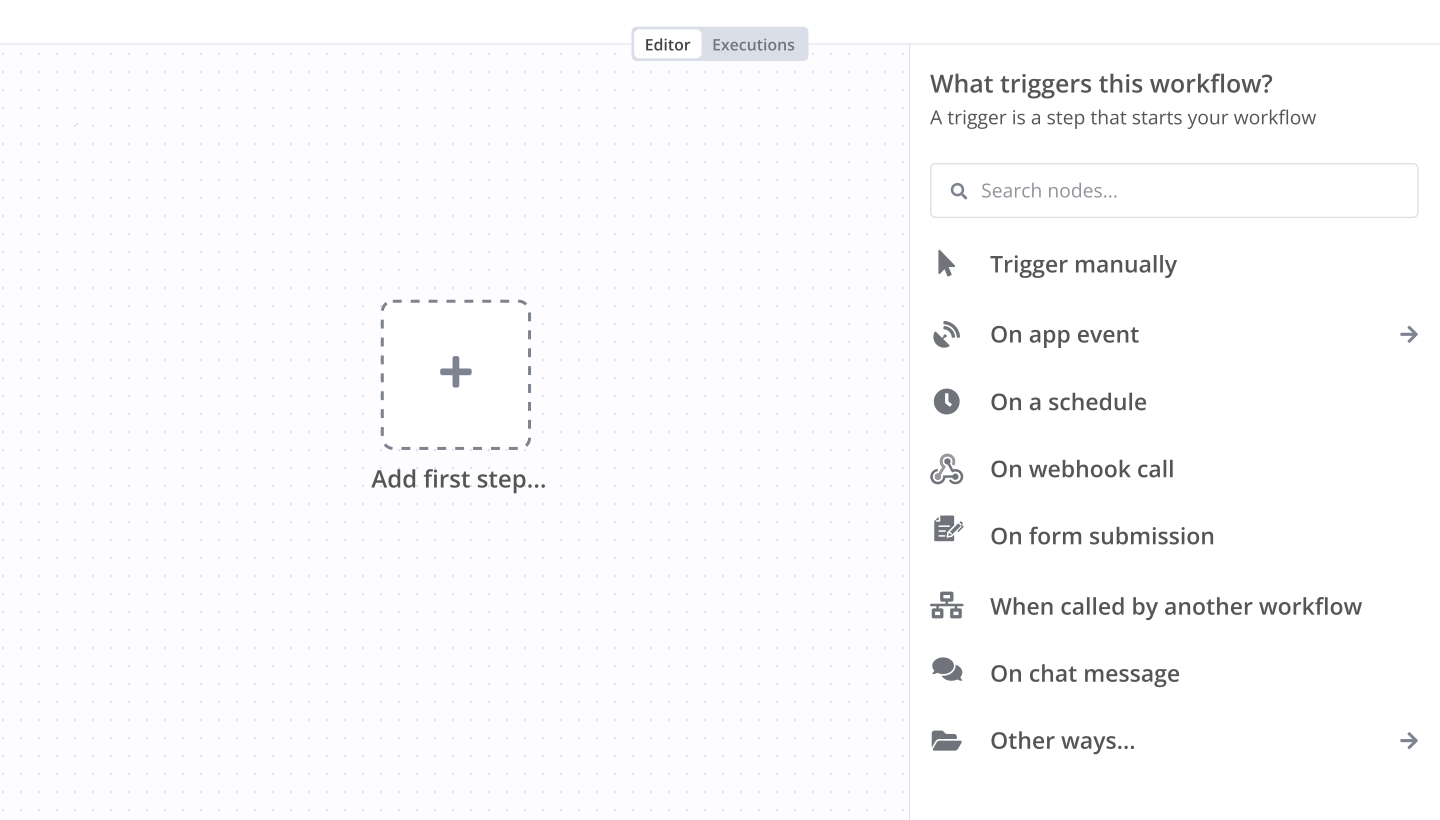
urlscan.io and Slack integration: Create a new workflow and add the first step

Step 2: Add and configure urlscan.io and Slack nodes

You can find urlscan.io and Slack in the nodes panel. Drag them onto your workflow canvas, selecting their actions. Click each node, choose a credential, and authenticate to grant n8n access. Configure urlscan.io and Slack nodes one by one: input data on the left, parameters in the middle, and output data on the right.

urlscan.io and Slack integration: Add and configure urlscan.io and Slack nodes

Step 3: Connect urlscan.io and Slack

A connection establishes a link between urlscan.io and Slack (or vice versa) to route data through the workflow. Data flows from the output of one node to the input of another. You can have single or multiple connections for each node.

urlscan.io and Slack integration: Connect urlscan.io and Slack

Step 4: Customize and extend your urlscan.io and Slack integration

Use n8n's core nodes such as If, Split Out, Merge, and others to transform and manipulate data. Write custom JavaScript or Python in the Code node and run it as a step in your workflow. Connect urlscan.io and Slack with any of n8n’s 1000+ integrations, and incorporate advanced AI logic into your workflows.

urlscan.io and Slack integration: Customize and extend your urlscan.io and Slack integration

Step 5: Test and activate your urlscan.io and Slack workflow

Save and run the workflow to see if everything works as expected. Based on your configuration, data should flow from urlscan.io to Slack or vice versa. Easily debug your workflow: you can check past executions to isolate and fix the mistake. Once you've tested everything, make sure to save your workflow and activate it.

urlscan.io and Slack integration: Test and activate your urlscan.io and Slack workflow

Phishing analysis - URLScan.io and VirusTotal

This n8n workflow automates the analysis of email messages received in a Microsoft Outlook inbox to identify indicators of compromise (IOCs), specifically suspicious URLs. It can be triggered manually or scheduled to run daily at midnight.

The workflow begins by retrieving up to 100 read email messages from the Outlook inbox. However, there seems to be a configuration issue as it should retrieve unread messages, not read ones. It then marks these messages as read to avoid processing them again in the future.

The messages are then split into individual items using the Split In Batches node for sequential processing. For each email, the workflow analyzes its content to find URLs, which are considered potential IOCs. If URLs are found, the workflow proceeds to check these URLs for potential threats using two services, URLScan.io and VirusTotal, in parallel.

In the first path, URLScan.io scans each URL, and if there are no errors, the results from URLScan.io and VirusTotal are merged. If there are errors, the workflow waits 1 minute before attempting to retrieve the URLScan results again. The loop then continues for the next email. In the second path, VirusTotal is used to scan the URLs, and the results are retrieved.

Finally, the workflow checks if the data field is not empty, filtering out items where no data was found. It then sends a summarized Slack message to report details about the analyzed email, including the subject, sender, date, URLScan report URL, and VirusTotal verdict for URLs that were reported as malicious.

Potential issues during setup include configuring the Outlook node to retrieve unread messages, resolving a configuration issue in the VirusTotal node, and handling authentication and API keys for both URLScan.io and VirusTotal nodes. Additionally, proper error handling and testing with various email content types and URLs are essential to ensure the workflow accurately identifies IOCs and reports them to the Slack channel.

Nodes used in this workflow

Popular urlscan.io and Slack workflows

Phishing Analysis - URLScan.io and VirusTotal

This n8n workflow automates the analysis of email messages received in a Microsoft Outlook inbox to identify indicators of compromise (IOCs), specifically suspicious URLs. It can be triggered manually or scheduled to run daily at midnight. The workflow begins by retrieving up to 100 read email messages from the Outlook inbox. However, there seems to be a configuration issue as it should retrieve unread messages, not read ones. It then marks these messages as read to avoid processing them again in the future. The messages are then split into individual items using the Split In Batches node for sequential processing. For each email, the workflow analyzes its content to find URLs, which are considered potential IOCs. If URLs are found, the workflow proceeds to check these URLs for potential threats using two services, URLScan.io and VirusTotal, in parallel. In the first path, URLScan.io scans each URL, and if there are no errors, the results from URLScan.io and VirusTotal are merged. If there are errors, the workflow waits 1 minute before attempting to retrieve the URLScan results again. The loop then continues for the next email. In the second path, VirusTotal is used to scan the URLs, and the results are retrieved. Finally, the workflow checks if the data field is not empty, filtering out items where no data was found. It then sends a summarized Slack message to report details about the analyzed email, including the subject, sender, date, URLScan report URL, and VirusTotal verdict for URLs that were reported as malicious. Potential issues during setup include configuring the Outlook node to retrieve unread messages, resolving a configuration issue in the VirusTotal node, and handling authentication and API keys for both URLScan.io and VirusTotal nodes. Additionally, proper error handling and testing with various email content types and URLs are essential to ensure the workflow accurately identifies IOCs and reports them to the Slack channel.

Monitor SSL certificates for brand-impersonating domains with crt.sh, Urlscan.io and Slack

Phishing Lookout (Typosquatting) and Brand Domain Monitor This workflow monitors SSL certificate logs to find and scan new domains that might be impersonating your brand. Background In modern cybersecurity, Brand Impersonation (or "Typosquatting") is quite common in phishing attacks. Attackers register domains that look nearly identical to a trusted brand—such as .input-n8n.io, n8n.i0, etc. instead of the legitimate— to deceive users into revealing sensitive credentials or downloading malware. How it works Monitor: Checks crt.sh every hour for new SSL certificates matching your brand keywords. Process: Uses a Split Out node to handle multi-domain certificates and a Filter node to ignore your own legitimate domains bringing only most recent certificates. Scan: Automatically sends suspicious domains to Urlscan.io for a headless browser scan and screenshot. Loop & Triage: Implements a 30-second Wait to allow the scan in loop to finish before fetching results. Alert: Sends a Slack message with the domain name, report link, and an image of the supposedly suspicious site trying to mimic your site login page, etc. alerting potentially a phishing case. Setup Steps Credentials: Connect your Urlscan.io API key and Slack bot token. Configuration: Update the "Poll crt.sh" node. In URL https://crt.sh/?q=%.testdomain.com&output=json, use your specific brand name (e.g., %.yourbrand.com or .yourdomain.com instead of .testdomain.com). Whitelist: Add your real domains to the myDomains list in the Filter & Deduplicate code node to prevent false alerts. Alternatively, you may also NOT opt to include your own domain for testing purposes to check how the Workflow behaves and outputs. In such case, obviously, your domain and sub-domains also are highlighted as Suspicious (as received in Slack Alerts) Looping: Ensure the Alert Slack node output is connected back to the Split In Batches input to process all found domains.

Build your own urlscan.io and Slack integration

Create custom urlscan.io and Slack workflows by choosing triggers and actions. Nodes come with global operations and settings, as well as app-specific parameters that can be configured. You can also use the HTTP Request node to query data from any app or service with a REST API.


urlscan.io supported actions

Get
Get Many
Perform

Slack supported actions

Archive
Archives a conversation
Close
Closes a direct message or multi-person direct message
Create
Initiates a public or private channel-based conversation
Get
Get information about a channel
Get Many
Get many channels in a Slack team
History
Get a conversation's history of messages and events
Invite
Invite a user to a channel
Join
Joins an existing conversation
Kick
Removes a user from a channel
Leave
Leaves a conversation
Member
List members of a conversation
Open
Opens or resumes a direct message or multi-person direct message
Rename
Renames a conversation
Replies
Get a thread of messages posted to a channel
Set Purpose
Sets the purpose for a conversation
Set Topic
Sets the topic for a conversation
Unarchive
Unarchives a conversation
Get
Get Many
Get & filters team files
Upload
Create or upload an existing file
Delete
Get Permalink
Search
Send
Send and Wait for Response
Update
Add
Adds a reaction to a message
Get
Get the reactions of a message
Remove
Remove a reaction of a message
Add
Add a star to an item
Delete
Delete a star from an item
Get Many
Get many stars of autenticated user
Get
Get information about a user
Get Many
Get a list of many users
Get User's Profile
Get a user's profile
Get User's Status
Get online status of a user
Update User's Profile
Update a user's profile
Add Users
Create
Disable
Enable
Get Many
Get Users
Update
Use case

Save engineering resources

Reduce time spent on customer integrations, engineer faster POCs, keep your customer-specific functionality separate from product all without having to code.

Learn more

FAQs

  • Can urlscan.io connect with Slack?

  • Can I use urlscan.io’s API with n8n?

  • Can I use Slack’s API with n8n?

  • Is n8n secure for integrating urlscan.io and Slack?

  • How to get started with urlscan.io and Slack integration in n8n.io?

Need help setting up your urlscan.io and Slack integration?

Discover our latest community's recommendations and join the discussions about urlscan.io and Slack integration.
Nicolas N
Muhammed Iqbal P B
Nicolas N

Looking to integrate urlscan.io and Slack in your company?

Over 3000 companies switch to n8n every single week

Why use n8n to integrate urlscan.io with Slack

Build complex workflows, really fast

Build complex workflows, really fast

Handle branching, merging and iteration easily.
Pause your workflow to wait for external events.

Code when you need it, UI when you don't

Simple debugging

Your data is displayed alongside your settings, making edge cases easy to track down.

Use templates to get started fast

Use 1000+ workflow templates available from our core team and our community.

Reuse your work

Copy and paste, easily import and export workflows.

Implement complex processes faster with n8n

red iconyellow iconred iconyellow icon