Back to Integrations
integrationWebhook node
integrationMicrosoft Outlook node

Webhook and Microsoft Outlook integration

Save yourself the work of writing custom integrations for Webhook and Microsoft Outlook and use n8n instead. Build adaptable and scalable Development, Core Nodes, Communication, and HITL workflows that work with your technology stack. All within a building experience you will love.

How to connect Webhook and Microsoft Outlook

  • Step 1: Create a new workflow
  • Step 2: Add and configure nodes
  • Step 3: Connect
  • Step 4: Customize and extend your integration
  • Step 5: Test and activate your workflow

Step 1: Create a new workflow and add the first step

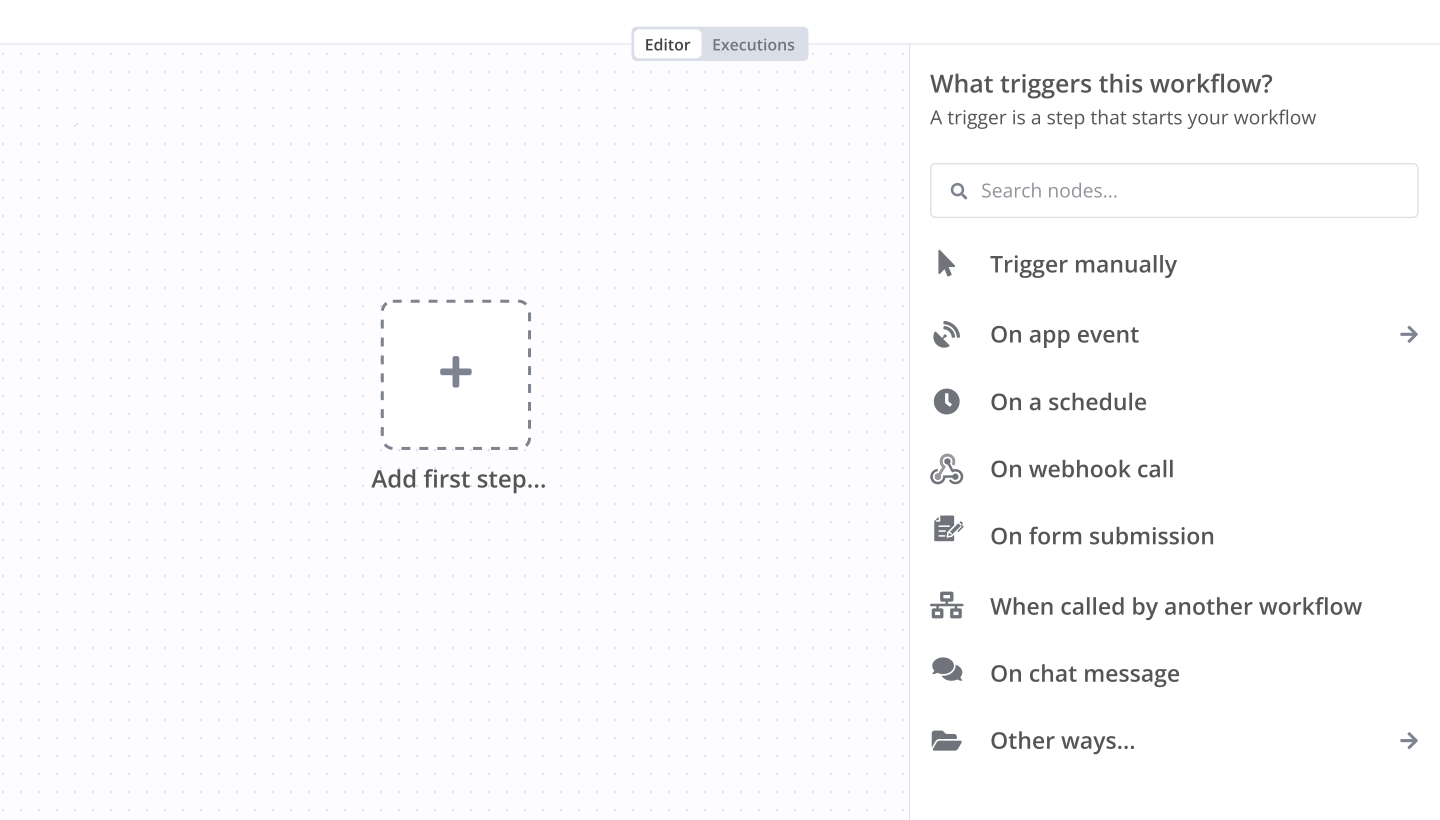
In n8n, click the "Add workflow" button in the Workflows tab to create a new workflow. Add the starting point – a trigger on when your workflow should run: an app event, a schedule, a webhook call, another workflow, an AI chat, or a manual trigger. Sometimes, the HTTP Request node might already serve as your starting point.

Webhook and Microsoft Outlook integration: Create a new workflow and add the first step

Step 2: Add and configure Webhook and Microsoft Outlook nodes

You can find Webhook and Microsoft Outlook in the nodes panel. Drag them onto your workflow canvas, selecting their actions. Click each node, choose a credential, and authenticate to grant n8n access. Configure Webhook and Microsoft Outlook nodes one by one: input data on the left, parameters in the middle, and output data on the right.

Webhook and Microsoft Outlook integration: Add and configure Webhook and Microsoft Outlook nodes

Step 3: Connect Webhook and Microsoft Outlook

A connection establishes a link between Webhook and Microsoft Outlook (or vice versa) to route data through the workflow. Data flows from the output of one node to the input of another. You can have single or multiple connections for each node.

Webhook and Microsoft Outlook integration: Connect Webhook and Microsoft Outlook

Step 4: Customize and extend your Webhook and Microsoft Outlook integration

Use n8n's core nodes such as If, Split Out, Merge, and others to transform and manipulate data. Write custom JavaScript or Python in the Code node and run it as a step in your workflow. Connect Webhook and Microsoft Outlook with any of n8n’s 1000+ integrations, and incorporate advanced AI logic into your workflows.

Webhook and Microsoft Outlook integration: Customize and extend your Webhook and Microsoft Outlook integration

Step 5: Test and activate your Webhook and Microsoft Outlook workflow

Save and run the workflow to see if everything works as expected. Based on your configuration, data should flow from Webhook to Microsoft Outlook or vice versa. Easily debug your workflow: you can check past executions to isolate and fix the mistake. Once you've tested everything, make sure to save your workflow and activate it.

Webhook and Microsoft Outlook integration: Test and activate your Webhook and Microsoft Outlook workflow

AI-driven lead management and inquiry automation with ERPNext & n8n

Overview
This workflow template automates lead management and customer inquiry processing by integrating ERPNext, AI agents, and email notifications. It streamlines the process of capturing leads, analyzing inquiries, and generating actionable responses. The workflow uses ERPNext to capture inquiries, analyzes them with AI, and notifies the appropriate team or individual, all while maintaining a professional approach.

What This Template Does
ERPNext Webhook Integration:
Captures leads and inquiries through ERPNext webhooks.
Triggers the workflow when a new lead is created.

AI-Powered Inquiry Analysis:
Uses AI to extract key details from lead notes (e.g., customer name, organization, inquiry summary).
Classifies inquiries as valid or invalid based on relevance to products, services, or solutions.

Contact Assignment:
Matches inquiries to the appropriate contact(s) using a Google Sheets database or ERPNext contact information.
Handles multiple contacts if required.

Email Notifications:
Generates professional email notifications for valid inquiries.
Sends emails to the appropriate contact(s) with inquiry details and action steps.

Invalid Lead Handling:
Identifies invalid inquiries (e.g., unrelated to products or services) and flags them for follow-up or dismissal.

Custom Email Formatting:
Converts plain text into professionally formatted HTML emails.
Ensures that communication is clear, concise, and visually appealing.

How It Works

Step 1: Capture Lead Data
Webhook in ERPNext:**
Create a webhook in ERPNext for the "Lead" DocType.
Set the trigger to on_insert to capture new leads in real-time.

Lead Details:**
The workflow fetches lead details, including notes, contact information, and the source of the lead.

Step 2: Validate and Analyze Inquiry
AI Agent for Analysis:**
An AI agent analyzes the lead notes to extract key details and classify the inquiry as valid or invalid.
The analysis includes checking the relevance of the inquiry to products, services, or solutions offered by the company.

Invalid Leads:**
If the inquiry is invalid, the workflow flags it and stops further processing.

Step 3: Assign Contact(s)
Google Sheets Integration:**
Uses a Google Sheets database to map products, services, or solutions to responsible contacts.
Ensures that inquiries are directed to the right person or team.

Multiple Contacts:**
Handles cases where multiple contacts are responsible for a particular product or service.

Step 4: Generate and Send Email Notifications
AI-Generated Emails:**
The workflow generates a professional email summarizing the inquiry.
Emails include details like customer name, organization, inquiry summary, and action steps.

Custom HTML Formatting:**
Emails are converted to HTML for a polished and professional appearance.

Send Notifications:**
Sends email notifications through Microsoft Outlook or another configured email client.
Optionally, notifies via WhatsApp or SMS for urgent inquiries.

Step 5: Post-Inquiry Actions
ERPNext Record Updates:**
Updates the lead record in ERPNext with relevant details, including inquiry status and contact information.

Setup Instructions

Prerequisites
ERPNext:
A configured ERPNext instance with lead data and a webhook for the "Lead" DocType.
Google Sheets:
A sheet mapping products, services, or solutions to responsible contacts.
AI Integration:
Credentials for OpenAI or other supported AI platforms.
Email Client:
Credentials for Microsoft Outlook or another email client.

Step-by-Step Setup
ERPNext Configuration:
Create a webhook for the "Lead" DocType in ERPNext.
Test the webhook with sample data to ensure proper integration.

Workflow Import:
Import the workflow template into n8n.
Configure nodes with your API credentials for ERPNext, Google Sheets, and AI tools.

Google Sheets Integration:
Prepare a Google Sheet with columns for product, service, or solution and the responsible contact(s).
Link the sheet to the workflow.

AI Agent Configuration:
Customize the AI agent’s prompts to align with your business’s products and services.
Adjust criteria for valid and invalid inquiries as needed.

Email Setup:
Configure the email client node with your email service credentials.
Customize the email template for your organization.

Testing:
Run the workflow with sample leads to validate the entire process.
Check email notifications, contact assignments, and record updates in ERPNext.

Dos and Don’ts

Dos:
Test Thoroughly:** Test the workflow with various scenarios before deploying in production.
Secure Credentials:** Keep API and email credentials secure to avoid unauthorized access.
Customize Prompts:** Tailor AI prompts to match your business needs and language style.
Use Professional Email Templates:** Ensure emails are clear and well-formatted.

Don’ts:
Skip Validation:** Always validate inquiry data to avoid sending irrelevant notifications.
Overload the Workflow:** Avoid adding unnecessary nodes that can slow down processing.
Ignore Errors:** Monitor logs and address errors promptly for a smooth workflow.

Resources
GET n8n Now

N8N COURSE
n8n Book

YouTube Tutorial:**
Watch the full step-by-step tutorial on setting up this workflow:
SyncBricks YouTube Channel

Courses and Training:**
Learn more about ERPNext and AI automation through my comprehensive courses:
SyncBricks LMS

Support and Contact:**
Email: [email protected]
Website: SyncBricks
LinkedIn: Amjid Ali

Nodes used in this workflow

Popular Webhook and Microsoft Outlook workflows

Automated Invoice Creation & Customer Communication with Jotform, Xero, Outlook & Telegram

Automated Invoice Creation & Team Notification with Jotform, Xero, Outlook, and Telegram This workflow automates the entire process of receiving a product/service order, checking or creating a customer in Xero, generating an invoice, emailing it, and notifying the sales team for example after sometime if no action has been taken yet (via Telegram) — all triggered by a form submission (via Jotform). How It Works Receive Submission Triggered when a user submits a form. Collects data like customer details, selected product/service, etc. Check If Customer Exists Searches Xero to determine if the customer already exists. ✅ If Customer Exists: Update customer details. ❌ If Customer Doesn’t Exist: Create a new customer in Xero. Create The Invoice Generates a new invoice for the customer using the item selected. Send The Invoice Automatically sends the invoice via email to the customer. Wait For Sometime Now we will wait for 30 seconds (by default, you can change it) and then get the invoice details from Xero Notify The Team Notifies the sales team for example via Telegram in case no action has been taken on the invoice and thus the team can act fast. Who Can Benefit from This Workflow? Freelancers** Service Providers** Consultants & Coaches** Small Businesses** E-commerce or Custom Product Sellers** Requirements Jotform webhook setup, more info here Xero credentials, more info here Make sure that products/services values in Jotform are exactly the same as your item Code in your Xero account Email setup, update email node (Send email), more info about Outlook setup here LLM model credentials Telegram credentials, more info here
+3

Bilingual Newsletters with GPT-4o, AI Images & Videos for HubSpot & SP

Who’s it for Marketing, growth, and automation teams that need to ship polished bilingual newsletters—complete with images, optional video, and multi-channel distribution—without writing a line of code. How it works / What it does A Webhook receives a plain-language request (e.g. “Create a newsletter about XYZ and store it in SharePoint”). The Webhook can be changed to another trigger, fr example Manual Trigger. An AI Agent (OpenAI GPT-4o) drafts German & English newsletter copy following a strict JSON schema. SharePoint fetches an HTML template; a Code node injects AI copy into the placeholders. Optional creative assets: Pollinations AI → image (resolution check & frame overlay) FAL AI → short video + Lyria2 audio → merged via FFmpeg API A Gmail Approval step sends the draft to an approver; the flow continues only on “Approve”. Depending on user intent the workflow: Emails the newsletter to HubSpot contacts, and/or Saves HTML (+ JPG/Video URL) to a SharePoint library. How to set up Import the template Open the yellow sticky note and follow the checklist Create credentials for OpenAI, HubSpot (App Token), Microsoft 365, Gmail, and FAL AI. Enter them in n8n Credential Manager (never in the HTTP node). Edit the Configuration Settings Set node with your ENV_* variables. Activate the workflow, copy the production Webhook URL, and trigger it with JSON body { "text": "…" } or with a desired trigger. Requirements OpenAI account Microsoft 365 tenant (SharePoint & Outlook) HubSpot App Token FAL AI API Key (video & audio generation) How to customize Want a different language? Tweak the AI prompt inside AI Agent. Want a different storage provider? Change the SharePoint nodes to Google Drive or Dropbox. Skip video generation: set include_video to false in the incoming prompt. Change the distribution logic by adjusting the WF Result Switch node. Add more channels (e.g. Slack) by inserting additional branches after the Switch and modifying the intent determination at the beginning of the workflow.
+2

Automate Microsoft Teams Meeting Analysis with GPT-4.1, Outlook & Mem.ai

Automate Microsoft Teams Meeting Analysis with GPT-4.1, Outlook & Mem.ai Watch the YouTube video to get started Follow along with the blog post Template Overview This advanced n8n template automates Microsoft Teams meeting analysis, knowledge base creation, and email drafting directly from meeting recordings and transcripts. It provides end-to-end automation for the following use cases: Meeting Analysis Connects to Microsoft Graph to retrieve meeting recordings, chat messages, and transcripts. Analyses meeting content using AI models. Extracts key points, action items, questions, and themes from meetings automatically. AI-Powered Web App Automatically creates a detailed report from past meetings. Stores meeting summaries, metadata, and insights into an easy-to-browse frontend. New meetings are added dynamically without manual work. ** Knowledge Base Indexing (via Mem.ai)** Uploads extracted meeting data into a structured knowledge base. Supports categorisation, search and chat functionality across meetings. Draft Follow-Up Emails** Draft personalised follow-up emails for meeting participants. Email drafts include: Meeting summary Key decisions Action items Emails can be sent manually with a human in the loop context via Microsoft Outlook integration. Core Components Microsoft Graph API for accessing meetings, chats, files, and user profiles. SharePoint API for file storage and search. n8n Webhooks to trigger processes dynamically. Generic OAuth2 authentication for seamless Microsoft access. JavaScript Code Nodes for flexible, intelligent parsing and structuring of meeting data. AI/LLM nodes for summarisation and content creation. Designed to be scalable, modular, and easily customisable for different organisation sizes and industries. 🛡️ Note Failure to correctly configure Azure permissions will prevent the template from functioning. Ensure admin approval is fully completed during setup. Important Prerequisites ⚠️ Administrator consent is required This template requires a Microsoft 365 Global Administrator or Application Administrator to grant admin consent to a set of Microsoft Graph and SharePoint API scopes. Basic Azure App Registration knowledge is required: You need to set up an Azure App Registration manually, configure OAuth2 authentication, and assign specific API permissions. A setup guide is included, but familiarity with: App registrations API permissions Client secrets OAuth2 flows is highly recommended. Knowledge of Postgres is required The template includes a SQL script to create the required Postgres table (see blog post). You are responsible for hosting your own database (You can use Supabase with the Postgres connection string).

AI-Driven Lead Management and Inquiry Automation with ERPNext & n8n

Overview This workflow template automates lead management and customer inquiry processing by integrating ERPNext, AI agents, and email notifications. It streamlines the process of capturing leads, analyzing inquiries, and generating actionable responses. The workflow uses ERPNext to capture inquiries, analyzes them with AI, and notifies the appropriate team or individual, all while maintaining a professional approach. What This Template Does ERPNext Webhook Integration: Captures leads and inquiries through ERPNext webhooks. Triggers the workflow when a new lead is created. AI-Powered Inquiry Analysis: Uses AI to extract key details from lead notes (e.g., customer name, organization, inquiry summary). Classifies inquiries as valid or invalid based on relevance to products, services, or solutions. Contact Assignment: Matches inquiries to the appropriate contact(s) using a Google Sheets database or ERPNext contact information. Handles multiple contacts if required. Email Notifications: Generates professional email notifications for valid inquiries. Sends emails to the appropriate contact(s) with inquiry details and action steps. Invalid Lead Handling: Identifies invalid inquiries (e.g., unrelated to products or services) and flags them for follow-up or dismissal. Custom Email Formatting: Converts plain text into professionally formatted HTML emails. Ensures that communication is clear, concise, and visually appealing. How It Works Step 1: Capture Lead Data Webhook in ERPNext:** Create a webhook in ERPNext for the "Lead" DocType. Set the trigger to on_insert to capture new leads in real-time. Lead Details:** The workflow fetches lead details, including notes, contact information, and the source of the lead. Step 2: Validate and Analyze Inquiry AI Agent for Analysis:** An AI agent analyzes the lead notes to extract key details and classify the inquiry as valid or invalid. The analysis includes checking the relevance of the inquiry to products, services, or solutions offered by the company. Invalid Leads:** If the inquiry is invalid, the workflow flags it and stops further processing. Step 3: Assign Contact(s) Google Sheets Integration:** Uses a Google Sheets database to map products, services, or solutions to responsible contacts. Ensures that inquiries are directed to the right person or team. Multiple Contacts:** Handles cases where multiple contacts are responsible for a particular product or service. Step 4: Generate and Send Email Notifications AI-Generated Emails:** The workflow generates a professional email summarizing the inquiry. Emails include details like customer name, organization, inquiry summary, and action steps. Custom HTML Formatting:** Emails are converted to HTML for a polished and professional appearance. Send Notifications:** Sends email notifications through Microsoft Outlook or another configured email client. Optionally, notifies via WhatsApp or SMS for urgent inquiries. Step 5: Post-Inquiry Actions ERPNext Record Updates:** Updates the lead record in ERPNext with relevant details, including inquiry status and contact information. Setup Instructions Prerequisites ERPNext: A configured ERPNext instance with lead data and a webhook for the "Lead" DocType. Google Sheets: A sheet mapping products, services, or solutions to responsible contacts. AI Integration: Credentials for OpenAI or other supported AI platforms. Email Client: Credentials for Microsoft Outlook or another email client. Step-by-Step Setup ERPNext Configuration: Create a webhook for the "Lead" DocType in ERPNext. Test the webhook with sample data to ensure proper integration. Workflow Import: Import the workflow template into n8n. Configure nodes with your API credentials for ERPNext, Google Sheets, and AI tools. Google Sheets Integration: Prepare a Google Sheet with columns for product, service, or solution and the responsible contact(s). Link the sheet to the workflow. AI Agent Configuration: Customize the AI agent’s prompts to align with your business’s products and services. Adjust criteria for valid and invalid inquiries as needed. Email Setup: Configure the email client node with your email service credentials. Customize the email template for your organization. Testing: Run the workflow with sample leads to validate the entire process. Check email notifications, contact assignments, and record updates in ERPNext. Dos and Don’ts Dos: Test Thoroughly:** Test the workflow with various scenarios before deploying in production. Secure Credentials:** Keep API and email credentials secure to avoid unauthorized access. Customize Prompts:** Tailor AI prompts to match your business needs and language style. Use Professional Email Templates:** Ensure emails are clear and well-formatted. Don’ts: Skip Validation:** Always validate inquiry data to avoid sending irrelevant notifications. Overload the Workflow:** Avoid adding unnecessary nodes that can slow down processing. Ignore Errors:** Monitor logs and address errors promptly for a smooth workflow. Resources GET n8n Now N8N COURSE n8n Book YouTube Tutorial:** Watch the full step-by-step tutorial on setting up this workflow: SyncBricks YouTube Channel Courses and Training:** Learn more about ERPNext and AI automation through my comprehensive courses: SyncBricks LMS Support and Contact:** Email: [email protected] Website: SyncBricks LinkedIn: Amjid Ali

Auto-Create Geotab Zone for New Salesforce Work Order

📝 DESCRIPTION OF THE WORKFLOW This workflow connects Salesforce and Geotab to streamline fleet tracking for field service jobs (Work Orders). When a new Work Order is created in Salesforce (with a 'New' status and valid coordinates), it creates a circular geofence zone in Geotab and updates the Work Order with the zone ID. If geolocation is missing, an alert email is sent to dedicated email. The workflow uses a Salesforce Outbound Message to trigger an n8n webhook. It includes robust credential handling and optional logic to skip or notify on bad data. Use Cases: Automating vehicle geofence setup for service visits Enhancing CRM-to-fleet system synchronisation Enforcing work orders data quality via alerts Integrations Used: Salesforce Geotab API Microsoft Outlook (or any SMTP-compatible service) Tags: geotab, salesforce, fleet management, gps tracking, field service, crm, automation, webhook, integration ADDITIONAL RESOURCES 🔗 Salesforce Salesforce Login \[Salesforce Setup (Admin Console)]\(https://login.salesforce.com/ → click “Setup” gear icon) Outbound Messages Documentation Salesforce Developer Documentation Salesforce Workbench (API Testing Tool) 🔗 Geotab Geotab Login (MyGeotab) Geotab Developer Portal Geotab API Explorer Geotab SDK (JavaScript Samples) Geotab Support Centre
+2

AI-Powered Candidate Shortlisting Automation for ERPNext

Template Guide for Employee Shortlisting AI Agent Automation Overview This template automates the process of shortlisting job applicants using ERPNext, n8n, and AI-powered decision-making tools like Google Gemini and OpenAI. It reduces manual effort, ensures fast evaluations, and provides justifiable decisions about applicants. This is ideal for businesses aiming to streamline their recruitment process while maintaining accuracy and professionalism. YouTube Tutorial:** For a full walkthrough of this template, visit: Integrate AI in ERPNext: Automate Recruitment Job Applicant Shortlisting in Seconds! What Does This Template Do? Webhook Integration with ERPNext: Automatically triggers the workflow when a job application is created in ERPNext. Resume Validation: Ensures resumes are attached and correctly processes various file formats like PDF and DOC. AI-Powered Evaluation: Uses AI to compare resumes against job descriptions and provides a: Fit Level (Strong, Moderate, or Weak) Score (0–100) Justification for the decision. Automated Decision Making: Based on AI-generated scores: Candidates with a score of 80 or higher are Accepted. Candidates below 80 are Rejected. Applications missing required fields or attachments are put On Hold. ERPNext Integration: Updates applicant records in ERPNext, including custom fields such as justification, fit level, and scores. Notifications: Notifies candidates via email, WhatsApp, or SMS about their application status. Step-by-Step Guide Step 1: Set Up ERPNext Webhook Go to Webhooks in ERPNext. Create a webhook for the Job Applicant DocType. Set the trigger to Insert. Pin and test the webhook to ensure proper data flow. Step 2: Import the Template into n8n Open your n8n instance. Import the provided workflow template. Check all nodes for proper configuration. Step 3: Configure Credentials Add your ERPNext API credentials to the ERPNext nodes. Add credentials for AI services like OpenAI or Google Gemini. Configure additional services like WhatsApp or email if you plan to use them for notifications. Step 4: Test Resume Validation Test how the workflow handles different file types (e.g., PDF, DOC, JPG). Ensure resumes without the proper format or attachment are flagged and rejected. Step 5: AI Evaluation The AI model (Google Gemini or OpenAI) will evaluate resumes against job descriptions. Customize the AI prompt to suit your job evaluation needs. The output will include a Fit Level, Score, Rating, and Justification. Step 6: Decision Automation The workflow automatically categorizes applicants: Accepted for scores ≥ 80. Rejected for scores < 80. On Hold if essential fields or attachments are missing. Step 7: Update ERPNext Records The workflow updates the Job Applicant record in ERPNext with: Status (Accepted, Rejected, On Hold) AI-generated Fit Level, Score, Rating, and Justification. Step 8: Notify Candidates Configure notification nodes (email, WhatsApp, or SMS). Inform candidates about their application status and include feedback if required. How It Works Trigger: The workflow starts when a job application is submitted in ERPNext. Validation: Checks if the resume is attached and in the correct format. AI Evaluation: Compares the resume with the job description and generates a decision. ERPNext Update: Updates the applicant's record with the decision and justification. Notification: Sends a personalized notification to the candidate. Dos and Don’ts Dos: Customize Prompts:** Tailor the AI prompt to match your specific job evaluation requirements. Test the Workflow:** Run sample data to ensure the process works as intended. Secure Your Credentials:** Keep your API credentials safe and do not share them publicly. Optimize for Different Formats:** Ensure the workflow can handle all types of resumes you expect. Don’ts: Avoid Manual Intervention:** Let the workflow handle most of the tasks to ensure efficiency. Do Not Skip Testing:** Always test the workflow with various scenarios to avoid errors. Do Not Overlook Notifications:** Ensure candidates are notified promptly to maintain professionalism. Customization Options Add logic for more file types (e.g., scanned images using OCR). Enhance the AI prompts to analyze more complex resume data. Integrate additional tools like Slack or Trello for recruitment tracking. Resources GET n8n Now N8N COURSE n8n Book YouTube Tutorial:** For a full walkthrough of this template, visit: SyncBricks YouTube Channel Detailed Guides and Courses:** Learn more about ERPNext and AI-driven automation at: SyncBricks LMS Support If you encounter issues or want to explore more possibilities with AI-driven automation, feel free to reach out: Email:** [email protected] Website:** ERPNext and Other Courses LinkedIn:** Amjid Ali Let me know if you'd like further details or modifications to the guide!

Build your own Webhook and Microsoft Outlook integration

Create custom Webhook and Microsoft Outlook workflows by choosing triggers and actions. Nodes come with global operations and settings, as well as app-specific parameters that can be configured. You can also use the HTTP Request node to query data from any app or service with a REST API.

Microsoft Outlook supported actions

Create
Create a new calendar
Delete
Delete a calendar
Get
Retrieve a calendar
Get Many
List and search calendars
Update
Update a calendar
Create
Create a new contact
Delete
Delete a contact
Get
Retrieve a contact
Get Many
List and search contacts
Update
Update a contact
Create
Create a new email draft
Delete
Delete an email draft
Get
Retrieve an email draft
Send
Send an existing email draft
Update
Update an email draft
Create
Create a new event
Delete
Delete an event
Get
Retrieve an event
Get Many
List and search events
Update
Update an event
Create
Create a mail folder in the root folder of the user's mailbox
Delete
Delete a folder
Get
Retrieve a folder
Get Many
Get many folders
Update
Update a folder
Get Many
Retrieves the messages in a folder
Delete
Delete a message
Get
Retrieve a single message
Get Many
List and search messages
Move
Move a message to a folder
Reply
Create a reply to a message
Send
Send a message
Send and Wait for Response
Send a message and wait for response
Update
Update a message
Add
Add an attachment to a message
Download
Download an attachment from a message
Get
Retrieve information about an attachment of a message
Get Many
Retrieve information about the attachments of a message

Webhook and Microsoft Outlook integration details

integrationWebhook node
Webhook

Webhooks are automatic notifications that apps send when something occurs. They are sent to a certain URL, which is effectively the app's phone number or address, and contain a message or payload. Polling is nearly never quicker than webhooks, and it takes less effort from you.

Use case

Save engineering resources

Reduce time spent on customer integrations, engineer faster POCs, keep your customer-specific functionality separate from product all without having to code.

Learn more

FAQs

  • Can Webhook connect with Microsoft Outlook?

  • Can I use Webhook’s API with n8n?

  • Can I use Microsoft Outlook’s API with n8n?

  • Is n8n secure for integrating Webhook and Microsoft Outlook?

  • How to get started with Webhook and Microsoft Outlook integration in n8n.io?

Need help setting up your Webhook and Microsoft Outlook integration?

Discover our latest community's recommendations and join the discussions about Webhook and Microsoft Outlook integration.
Benjamin Hatton
Albert Ashkhatoyan
Víctor González
Salomão
sg tech

Looking to integrate Webhook and Microsoft Outlook in your company?

Over 3000 companies switch to n8n every single week

Why use n8n to integrate Webhook with Microsoft Outlook

Build complex workflows, really fast

Build complex workflows, really fast

Handle branching, merging and iteration easily.
Pause your workflow to wait for external events.

Code when you need it, UI when you don't

Simple debugging

Your data is displayed alongside your settings, making edge cases easy to track down.

Use templates to get started fast

Use 1000+ workflow templates available from our core team and our community.

Reuse your work

Copy and paste, easily import and export workflows.

Implement complex processes faster with n8n

red iconyellow iconred iconyellow icon