Back to Integrations
integrationDeepL node
integrationSlack node

DeepL and Slack integration

Save yourself the work of writing custom integrations for DeepL and Slack and use n8n instead. Build adaptable and scalable Utility, Communication, and HITL workflows that work with your technology stack. All within a building experience you will love.

How to connect DeepL and Slack

  • Step 1: Create a new workflow
  • Step 2: Add and configure nodes
  • Step 3: Connect
  • Step 4: Customize and extend your integration
  • Step 5: Test and activate your workflow

Step 1: Create a new workflow and add the first step

In n8n, click the "Add workflow" button in the Workflows tab to create a new workflow. Add the starting point – a trigger on when your workflow should run: an app event, a schedule, a webhook call, another workflow, an AI chat, or a manual trigger. Sometimes, the HTTP Request node might already serve as your starting point.
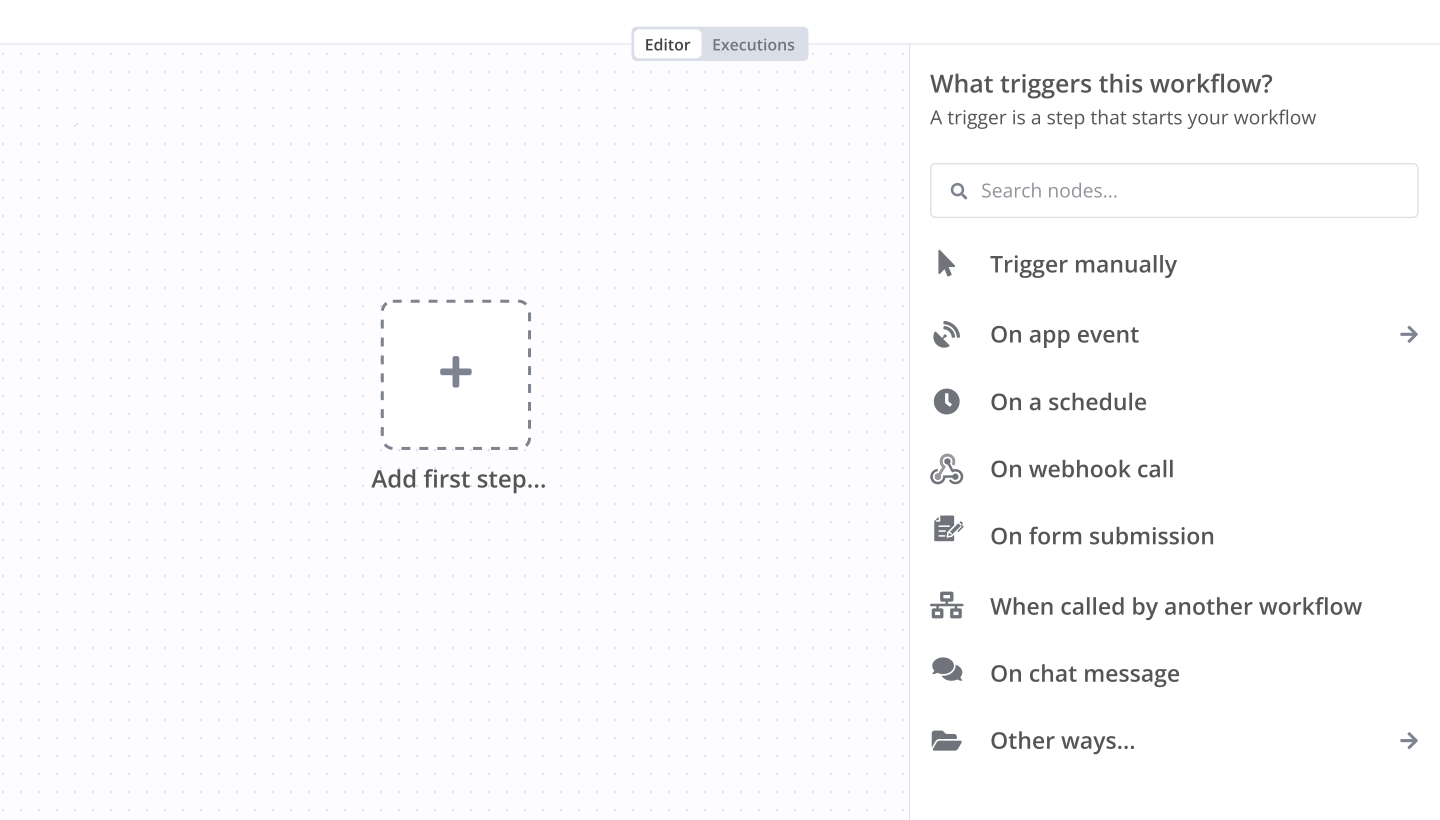
DeepL and Slack integration: Create a new workflow and add the first step

Step 2: Add and configure DeepL and Slack nodes

You can find DeepL and Slack in the nodes panel. Drag them onto your workflow canvas, selecting their actions. Click each node, choose a credential, and authenticate to grant n8n access. Configure DeepL and Slack nodes one by one: input data on the left, parameters in the middle, and output data on the right.

DeepL and Slack integration: Add and configure DeepL and Slack nodes

Step 3: Connect DeepL and Slack

A connection establishes a link between DeepL and Slack (or vice versa) to route data through the workflow. Data flows from the output of one node to the input of another. You can have single or multiple connections for each node.

DeepL and Slack integration: Connect DeepL and Slack

Step 4: Customize and extend your DeepL and Slack integration

Use n8n's core nodes such as If, Split Out, Merge, and others to transform and manipulate data. Write custom JavaScript or Python in the Code node and run it as a step in your workflow. Connect DeepL and Slack with any of n8n’s 1000+ integrations, and incorporate advanced AI logic into your workflows.

DeepL and Slack integration: Customize and extend your DeepL and Slack integration

Step 5: Test and activate your DeepL and Slack workflow

Save and run the workflow to see if everything works as expected. Based on your configuration, data should flow from DeepL to Slack or vice versa. Easily debug your workflow: you can check past executions to isolate and fix the mistake. Once you've tested everything, make sure to save your workflow and activate it.

DeepL and Slack integration: Test and activate your DeepL and Slack workflow

Translate multilingual content with DeepL, GPT-4, WordPress, Slack and Sheets

#Multi-Language Content Translation Pipeline with AI Quality Control

This workflow provides a professional-grade translation pipeline that combines the speed of DeepL with the intelligent reasoning of OpenAI's GPT-4. It is designed to help teams scale their global content reach without sacrificing linguistic accuracy or cultural nuance.

Who’s it for
This template is ideal for content managers, digital marketing teams, and global publishers who need to localize high volumes of articles or documentation while maintaining a "human-in-the-loop" quality standard.

How it works
The workflow automates the entire translation lifecycle through the following steps:
Trigger: Content is ingested via a Webhook or a recurring Schedule.
Translation: The source text is translated into multiple target languages simultaneously using the DeepL API.
AI Quality Guard: An OpenAI agent evaluates each translation, assigning a quality score based on accuracy and fluency.
Automated Publishing: Content that meets your quality threshold is automatically uploaded as a draft to WordPress.
Manual Review: Any translations that fall below the threshold are flagged in Slack for human intervention.
Data Logging: All results are saved to Google Sheets to build a searchable translation memory.

How to set up
Credentials: Connect your DeepL, OpenAI, WordPress, Slack, and Google Sheets accounts.
Configuration: In the 'Translation Configuration' node, define your source language and a list of target languages (e.g., DE, FR, JA).
Google Sheets: Create a sheet with headers: contentId, title, sourceLanguage, targetLanguage, translatedText, and qualityScore.
Slack: Choose the notification channels for alerts and summary reports.

Requirements
DeepL API key
OpenAI API key (GPT-4o or GPT-4o-mini recommended)
WordPress site with Application Passwords enabled
A Slack workspace and a Google Sheets account

How to customize the workflow
Adjust Quality Standards:** Change the qualityThreshold value in the configuration node to make the AI verification more or less strict.
Add Platforms:** Replace the WordPress node with other CMS nodes like Ghost, Strapi, or Contentful to match your stack.
Advanced QA:** Modify the AI Quality Reviewer’s prompt to focus on specific brand guidelines or industry terminology.

Nodes used in this workflow

Popular DeepL and Slack workflows

+2

Translate multilingual content with DeepL, GPT-4, WordPress, Slack and Sheets

#Multi-Language Content Translation Pipeline with AI Quality Control This workflow provides a professional-grade translation pipeline that combines the speed of DeepL with the intelligent reasoning of OpenAI's GPT-4. It is designed to help teams scale their global content reach without sacrificing linguistic accuracy or cultural nuance. Who’s it for This template is ideal for content managers, digital marketing teams, and global publishers who need to localize high volumes of articles or documentation while maintaining a "human-in-the-loop" quality standard. How it works The workflow automates the entire translation lifecycle through the following steps: Trigger: Content is ingested via a Webhook or a recurring Schedule. Translation: The source text is translated into multiple target languages simultaneously using the DeepL API. AI Quality Guard: An OpenAI agent evaluates each translation, assigning a quality score based on accuracy and fluency. Automated Publishing: Content that meets your quality threshold is automatically uploaded as a draft to WordPress. Manual Review: Any translations that fall below the threshold are flagged in Slack for human intervention. Data Logging: All results are saved to Google Sheets to build a searchable translation memory. How to set up Credentials: Connect your DeepL, OpenAI, WordPress, Slack, and Google Sheets accounts. Configuration: In the 'Translation Configuration' node, define your source language and a list of target languages (e.g., DE, FR, JA). Google Sheets: Create a sheet with headers: contentId, title, sourceLanguage, targetLanguage, translatedText, and qualityScore. Slack: Choose the notification channels for alerts and summary reports. Requirements DeepL API key OpenAI API key (GPT-4o or GPT-4o-mini recommended) WordPress site with Application Passwords enabled A Slack workspace and a Google Sheets account How to customize the workflow Adjust Quality Standards:** Change the qualityThreshold value in the configuration node to make the AI verification more or less strict. Add Platforms:** Replace the WordPress node with other CMS nodes like Ghost, Strapi, or Contentful to match your stack. Advanced QA:** Modify the AI Quality Reviewer’s prompt to focus on specific brand guidelines or industry terminology.
+3

Collect Viral Instagram AI Art with GPT-4 Analysis and Telegram Delivery

Who is this for? This template is perfect for: AI art enthusiasts** who want to stay updated on trending AI-generated artwork Content curators** looking to automate art discovery Japanese-speaking users** who want translated captions Social media managers** tracking AI art trends across platforms What this workflow does This workflow automatically collects viral AI art posts from Instagram and delivers them to your Telegram with Japanese translations. It runs daily and filters only high-engagement posts to ensure quality content. Key Features: 📸 Collects from 4 AI art hashtags (#AIart, #midjourney, #stablediffusion, #aiartwork) 🔥 Filters viral posts only (100+ likes threshold) 🇯🇵 Auto-translates captions to Japanese via DeepL ⚠️ Sends error alerts to Telegram if something goes wrong ⏱️ Built-in rate limiting to avoid API blocks How it works Schedule Trigger - Runs daily at 18:00 Instagram Scraping - Apify collects posts from multiple AI art hashtags Viral Filter - Only posts with 100+ likes and valid captions pass through Translation - DeepL translates captions from English to Japanese Image Download - Fetches the post image Telegram Delivery - Sends photo with translated caption, likes count, and source link Rate Limiting - 3-second delay between posts to avoid API limits Setup Requirements Apify account** - Sign up at apify.com for Instagram scraping DeepL API key** - Get free API access at deepl.com/pro-api Telegram Bot** - Create via @BotFather and get your Chat ID How to set up Import this workflow into n8n Set up credentials: Connect your Apify account Add your DeepL API key Configure Telegram Bot token Replace YOUR_TELEGRAM_CHAT_ID with your actual Chat ID in both Telegram nodes (Optional) Adjust the viral threshold in the Filter node (Optional) Modify hashtags in the Apify node Activate the workflow How to customize Change hashtags:** Edit the directUrls array in the Apify node Adjust viral threshold:** Change the 100 value in the Filter node Change schedule:** Modify the trigger time in the Schedule Trigger node Change language:** Update the translateTo parameter in the DeepL node Modify caption format:** Edit the caption template in the Telegram node

Transform NASA Patents into Business Ideas with OpenAI and Send to Google Sheets & Slack

Who is this for Entrepreneurs looking for verified technology to license. R&D Teams tracking aerospace innovation. Content Creators covering tech trends. How it works Fetch: Gets the latest patents from NASA's Tech Transfer API. Filter & Loop: Removes empty entries and processes each patent individually. Analyze: Translates the abstract (DeepL) and uses OpenAI to brainstorm practical business applications. Archive: Saves the details to Google Sheets. Notify: Compiles a summary and sends it to Slack. How to set up Prepare Google Sheet: Create a new sheet with these exact headers in Row 1: Date Title Abstract_Translated Business_Idea Link Edit Settings: Double-click the Edit Settings node to add your Google Sheet ID, Sheet Name, and Slack Channel ID. Credentials: Configure credentials for OpenAI, DeepL, Google Sheets, and Slack. Activate: Run a test execution, then switch the workflow to Active. Requirements OpenAI: API Key (gpt-4o or gpt-3.5-turbo) DeepL: API Key (Free or Pro) Google Sheets: OAuth2 credentials with Drive/Sheets scopes. Slack: Bot User OAuth Token with chat:write scope. How to customize Change the Prompt: Edit the Generate Business Ideas node to tailor ideas for a specific niche (e.g., "Applications for medical devices"). Adjust Schedule: Change the trigger in the Weekly Schedule node to run daily or monthly. Different Output: Swap Slack for Microsoft Teams or Email nodes if preferred.
+2

Daily News Digest & Weekly Trends with AI Filtering, Slack & Google Sheets

Who is this for This template is perfect for: Market Researchers** tracking industry trends. Tech Teams** wanting to stay updated on specific technologies (e.g., "AI", "Cybersecurity"). Content Creators** looking for curated news topics. Busy Professionals** who need a high-signal, low-noise news digest. What it does Fetches News: Pulls daily articles via NewsAPI based on your chosen keyword (default: "technology"). AI Filtering: Uses an AI Agent (via OpenRouter) to filter out low-quality or irrelevant clickbait. Daily Digest (Slack): Summarizes the top 3 articles in English. Translates the summaries to Japanese using DeepL (optional). Posts both versions to a Slack channel. Data Archiving (Sheets): Extracts structured data (Title, Author, Summary, URL) and saves it to Google Sheets. Weekly Trend Report: Every Monday, it reads the past week's data from Google Sheets and uses AI to generate a high-level trend report and strategic insights. How to set up Configure Credentials: You will need API keys/auth for NewsAPI, OpenRouter (or OpenAI), DeepL, Google Sheets, and Slack. Setup Google Sheet: Create a sheet with the following headers in the first row: title, author, summary, url. Map the Sheet: In the "Append row in sheet" and "Read sheet (weekly)" nodes, select your file and map the columns. Define Keyword: Open the "Set Keyword" node and change chatInput to the topic you want to track (e.g., "Crypto", "SaaS", "Climate Change"). Slack Setup: Select your desired channel in the Slack nodes. Requirements n8n** (Self-hosted or Cloud) NewsAPI** Key (Free tier available) OpenRouter** (or any LangChain compatible Chat Model like OpenAI) DeepL** API Key (for translation) Google Sheets** account Slack** Workspace How to customize Change the Language:** Remove the DeepL node if you only want English, or change the target language code. Adjust the Prompt:** Modify the "AI Agent (Filter)" system message to change how strict the news filtering is. Change Schedule:** Adjust the Cron nodes to run at your preferred time (currently set to Daily 8 AM and Weekly Monday 9 AM).

Multilingual Email Auto-Replies with DeepL, GPT-4o and Slack Human Approval

Who's it for Customer support teams, sales representatives, and international business professionals who need to handle multilingual email communication efficiently while maintaining quality control through human approval. How it works This workflow automates email responses by: Monitoring Gmail for emails with a specific label (e.g., "To_Process") Translating the email content using DeepL to your preferred language Generating an AI-powered summary and draft reply using OpenAI Requesting approval via Slack with a summary and one-click approval link Sending the reply only after human approval is received Removing the label to prevent reprocessing Set up steps Setup takes approximately 15-20 minutes: Configure credentials for Gmail, DeepL, OpenAI, and Slack Create a Gmail label for emails to process Update the Slack channel ID in the configuration node Ensure n8n is accessible via webhook (tunnel or production mode required) Requirements Gmail account with OAuth2 authentication DeepL API key (free tier available) OpenAI API key Slack workspace with OAuth2 app configured n8n instance accessible via webhook URL How to customize the workflow Change translation language**: Modify the DeepL node's target language Adjust AI model**: Switch between GPT-4 or GPT-3.5 in the OpenAI node Customize approval message**: Edit the Slack message format Add multiple languages**: Duplicate the translation node for multi-language support Filter specific senders**: Add conditions to process only certain email addresses

Japanese Document Translation Quality Checker with DeepL & Google Drive to Slack

Title Japanese Document Translation Quality Checker with DeepL & Google Drive to Slack Who’s it for Localization teams, QA reviewers, and operations leads who need a fast, objective signal on Japanese document translation quality without manual checks. What it does / How it works This workflow watches a Google Drive folder for new Japanese documents, exports the text, translates JA→EN with DeepL, then back-translates EN→JA. It compares the original and back-translation to estimate a quality score and summarizes differences. A Google Docs report is generated, and a Slack message posts the score, difference count, and report link—so teams can triage quickly. How to set up Connect credentials for Google Drive, DeepL, and Slack. Point the Google Drive Trigger to your “incoming JP docs” folder. In the Workflow Configuration (Set) node, fill targetFolder (report destination) and slackChannel. Run once, then activate and drop a test doc. Requirements n8n (Cloud or self-hosted), Google Drive, DeepL, and Slack credentials; two Drive folders (incoming, reports). How to customize the workflow Tune the diff logic (character → token/line level, normalization rules), adjust score thresholds and Slack formatting, or add reviewer routing/Jira creation for low-score cases. Always avoid hardcoded secrets; keep user-editable variables in the Set node.

Build your own DeepL and Slack integration

Create custom DeepL and Slack workflows by choosing triggers and actions. Nodes come with global operations and settings, as well as app-specific parameters that can be configured. You can also use the HTTP Request node to query data from any app or service with a REST API.

DeepL supported actions

Translate
Translate data

Slack supported actions

Archive
Archives a conversation
Close
Closes a direct message or multi-person direct message
Create
Initiates a public or private channel-based conversation
Get
Get information about a channel
Get Many
Get many channels in a Slack team
History
Get a conversation's history of messages and events
Invite
Invite a user to a channel
Join
Joins an existing conversation
Kick
Removes a user from a channel
Leave
Leaves a conversation
Member
List members of a conversation
Open
Opens or resumes a direct message or multi-person direct message
Rename
Renames a conversation
Replies
Get a thread of messages posted to a channel
Set Purpose
Sets the purpose for a conversation
Set Topic
Sets the topic for a conversation
Unarchive
Unarchives a conversation
Get
Get Many
Get & filters team files
Upload
Create or upload an existing file
Delete
Get Permalink
Search
Send
Send and Wait for Response
Update
Add
Adds a reaction to a message
Get
Get the reactions of a message
Remove
Remove a reaction of a message
Add
Add a star to an item
Delete
Delete a star from an item
Get Many
Get many stars of autenticated user
Get
Get information about a user
Get Many
Get a list of many users
Get User's Profile
Get a user's profile
Get User's Status
Get online status of a user
Update User's Profile
Update a user's profile
Add Users
Create
Disable
Enable
Get Many
Get Users
Update

FAQs

  • Can DeepL connect with Slack?

  • Can I use DeepL’s API with n8n?

  • Can I use Slack’s API with n8n?

  • Is n8n secure for integrating DeepL and Slack?

  • How to get started with DeepL and Slack integration in n8n.io?

Need help setting up your DeepL and Slack integration?

Discover our latest community's recommendations and join the discussions about DeepL and Slack integration.
Nicolas N
Muhammed Iqbal P B
Nicolas N

Looking to integrate DeepL and Slack in your company?

Over 3000 companies switch to n8n every single week

Why use n8n to integrate DeepL with Slack

Build complex workflows, really fast

Build complex workflows, really fast

Handle branching, merging and iteration easily.
Pause your workflow to wait for external events.

Code when you need it, UI when you don't

Simple debugging

Your data is displayed alongside your settings, making edge cases easy to track down.

Use templates to get started fast

Use 1000+ workflow templates available from our core team and our community.

Reuse your work

Copy and paste, easily import and export workflows.

Implement complex processes faster with n8n

red iconyellow iconred iconyellow icon