Back to Integrations
integrationGitHub node
integrationMicrosoft Teams node

GitHub and Microsoft Teams integration

Save yourself the work of writing custom integrations for GitHub and Microsoft Teams and use n8n instead. Build adaptable and scalable Development, Communication, and HITL workflows that work with your technology stack. All within a building experience you will love.

How to connect GitHub and Microsoft Teams

  • Step 1: Create a new workflow
  • Step 2: Add and configure nodes
  • Step 3: Connect
  • Step 4: Customize and extend your integration
  • Step 5: Test and activate your workflow

Step 1: Create a new workflow and add the first step

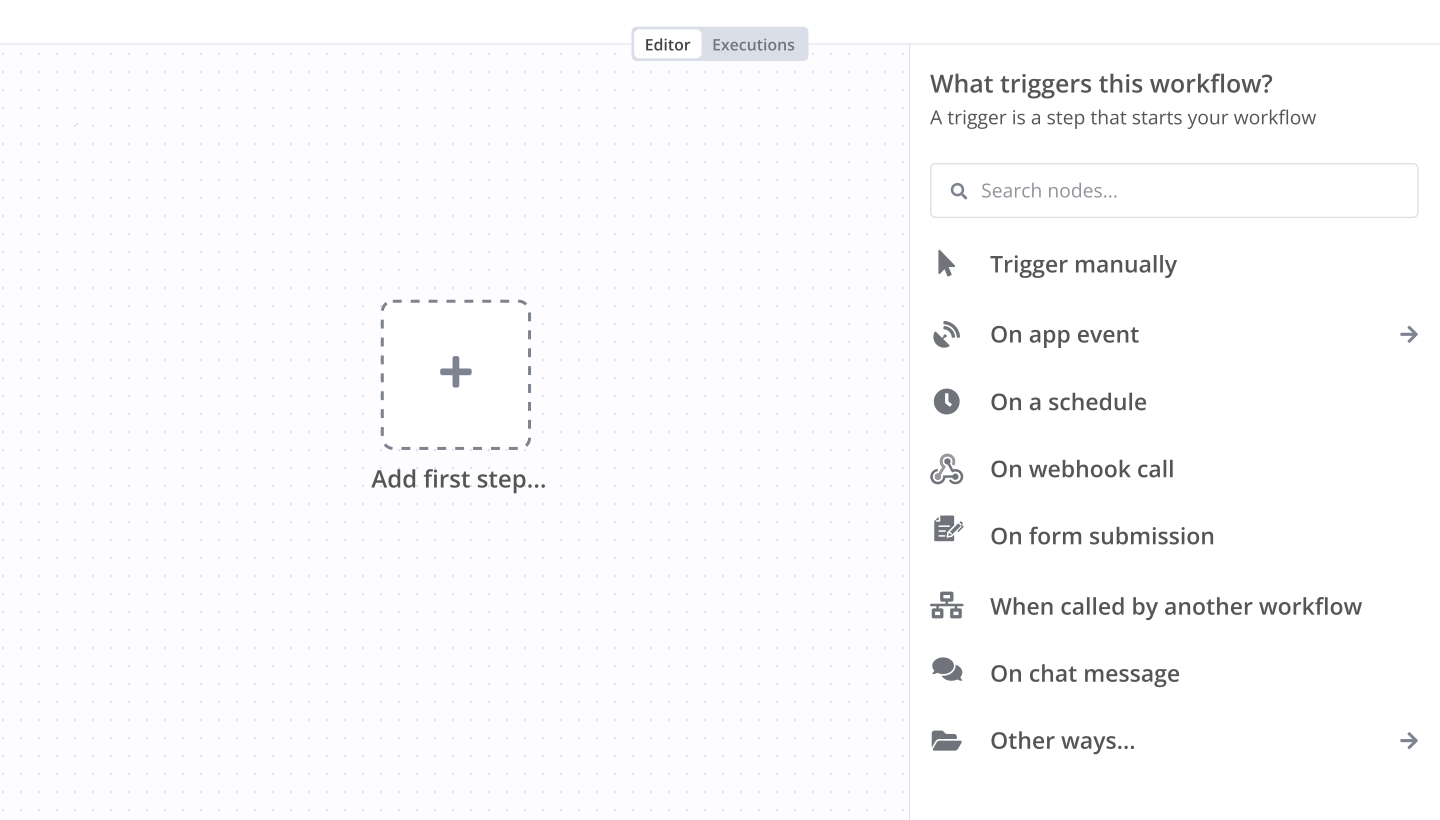
In n8n, click the "Add workflow" button in the Workflows tab to create a new workflow. Add the starting point – a trigger on when your workflow should run: an app event, a schedule, a webhook call, another workflow, an AI chat, or a manual trigger. Sometimes, the HTTP Request node might already serve as your starting point.

GitHub and Microsoft Teams integration: Create a new workflow and add the first step

Step 2: Add and configure GitHub and Microsoft Teams nodes

You can find GitHub and Microsoft Teams in the nodes panel. Drag them onto your workflow canvas, selecting their actions. Click each node, choose a credential, and authenticate to grant n8n access. Configure GitHub and Microsoft Teams nodes one by one: input data on the left, parameters in the middle, and output data on the right.

GitHub and Microsoft Teams integration: Add and configure GitHub and Microsoft Teams nodes

Step 3: Connect GitHub and Microsoft Teams

A connection establishes a link between GitHub and Microsoft Teams (or vice versa) to route data through the workflow. Data flows from the output of one node to the input of another. You can have single or multiple connections for each node.

GitHub and Microsoft Teams integration: Connect GitHub and Microsoft Teams

Step 4: Customize and extend your GitHub and Microsoft Teams integration

Use n8n's core nodes such as If, Split Out, Merge, and others to transform and manipulate data. Write custom JavaScript or Python in the Code node and run it as a step in your workflow. Connect GitHub and Microsoft Teams with any of n8n’s 1000+ integrations, and incorporate advanced AI logic into your workflows.

GitHub and Microsoft Teams integration: Customize and extend your GitHub and Microsoft Teams integration

Step 5: Test and activate your GitHub and Microsoft Teams workflow

Save and run the workflow to see if everything works as expected. Based on your configuration, data should flow from GitHub to Microsoft Teams or vice versa. Easily debug your workflow: you can check past executions to isolate and fix the mistake. Once you've tested everything, make sure to save your workflow and activate it.

GitHub and Microsoft Teams integration: Test and activate your GitHub and Microsoft Teams workflow

Aggregate & update documentation from Slack, Teams & GitHub with Claude Sonnet 4.5

How It Works
Aggregates communication data from Slack, Microsoft Teams, Gmail, GitHub, and Confluence into a single, unified AI-powered analysis workflow designed for quality review and automated documentation updates. This solution is specifically aimed at teams managing distributed content and knowledge workflows across multiple platforms. It addresses the challenges of fragmented communication and isolated information silos that often prevent rapid content review and timely decision-making. The workflow begins with a scheduled trigger, followed by multi-source data collection, merging and normalizing inputs, Claude AI-powered analysis, validation and quality checks, formatting, and finally publishing updates to Notion and Confluence, accompanied by Slack notifications to ensure stakeholders are promptly informed.

Setup Steps
-Connect credentials: Slack API, Teams, Gmail OAuth, GitHub PAT.
-Confluence API, Anthropic API key, Notion Integration.
-Configure monitored channels/repositories.
-Set schedule frequency.
-Map output destinations (Notion/Confluence).
-Test merged output before enabling automation.

Prerequisites
Slack workspace, Teams account, Gmail access, GitHub repository, Confluence space, Anthropic API key, Notion workspace, n8n instance.

Use Cases
Content review teams processing feedback, documentation teams aggregating updates, QA teams reviewing communications

Customization
Add/remove source nodes, adjust Claude prompts for analysis type, modify output destinations

Benefits
Saves 6+ hours weekly, eliminates missed content, AI-driven quality assurance

Nodes used in this workflow

Popular GitHub and Microsoft Teams workflows

+4

Aggregate & Update Documentation from Slack, Teams & GitHub with Claude Sonnet 4.5

How It Works Aggregates communication data from Slack, Microsoft Teams, Gmail, GitHub, and Confluence into a single, unified AI-powered analysis workflow designed for quality review and automated documentation updates. This solution is specifically aimed at teams managing distributed content and knowledge workflows across multiple platforms. It addresses the challenges of fragmented communication and isolated information silos that often prevent rapid content review and timely decision-making. The workflow begins with a scheduled trigger, followed by multi-source data collection, merging and normalizing inputs, Claude AI-powered analysis, validation and quality checks, formatting, and finally publishing updates to Notion and Confluence, accompanied by Slack notifications to ensure stakeholders are promptly informed. Setup Steps -Connect credentials: Slack API, Teams, Gmail OAuth, GitHub PAT. -Confluence API, Anthropic API key, Notion Integration. -Configure monitored channels/repositories. -Set schedule frequency. -Map output destinations (Notion/Confluence). -Test merged output before enabling automation. Prerequisites Slack workspace, Teams account, Gmail access, GitHub repository, Confluence space, Anthropic API key, Notion workspace, n8n instance. Use Cases Content review teams processing feedback, documentation teams aggregating updates, QA teams reviewing communications Customization Add/remove source nodes, adjust Claude prompts for analysis type, modify output destinations Benefits Saves 6+ hours weekly, eliminates missed content, AI-driven quality assurance

Build your own GitHub and Microsoft Teams integration

Create custom GitHub and Microsoft Teams workflows by choosing triggers and actions. Nodes come with global operations and settings, as well as app-specific parameters that can be configured. You can also use the HTTP Request node to query data from any app or service with a REST API.

GitHub supported actions

Create

Create a new file in repository
Delete
Delete a file in repository
Edit
Edit a file in repository
Get
Get the data of a single file
List
List contents of a folder
Create
Create a new issue
Create Comment
Create a new comment on an issue
Edit
Edit an issue
Get
Get the data of a single issue
Lock
Lock an issue
Get Repositories
Returns all repositories of an organization
Create
Creates a new release
Delete
Delete a release
Get
Get a release
Get Many
Get many repository releases
Update
Update a release
Get
Get the data of a single repository
Get Issues
Returns issues of a repository
Get License
Returns the contents of the repository's license file, if one is detected
Get Profile
Get the community profile of a repository with metrics, health score, description, license, etc
Get Pull Requests
Returns pull requests of a repository
List Popular Paths
Get the top 10 popular content paths over the last 14 days
List Referrers
Get the top 10 referrering domains over the last 14 days
Create
Creates a new review
Get
Get a review for a pull request
Get Many
Get many reviews for a pull request
Update
Update a review
Get Repositories
Returns the repositories of a user
Get Issues
Returns the issues assigned to the user
Invite
Invites a user to an organization
Disable
Disable a workflow
Dispatch
Dispatch a workflow event
Dispatch and Wait for Completion
Dispatch a workflow event and wait for a webhook to be called before proceeding
Enable
Enable a workflow
Get
Get a workflow
Get Usage
Get the usage of a workflow
List
List workflows

Microsoft Teams supported actions

Create
Create a channel
Delete
Delete a channel
Get
Get a channel
Get Many
Get many channels
Update
Update a channel
Create
Create a message in a channel
Get Many
Get many messages from a channel
Create
Create a message in a chat
Get
Get a message from a chat
Get Many
Get many messages from a chat
Send and Wait for Response
Send a message and wait for response
Create
Create a task
Delete
Delete a task
Get
Get a task
Get Many
Get many tasks
Update
Update a task

FAQs

  • Can GitHub connect with Microsoft Teams?

  • Can I use GitHub’s API with n8n?

  • Can I use Microsoft Teams’s API with n8n?

  • Is n8n secure for integrating GitHub and Microsoft Teams?

  • How to get started with GitHub and Microsoft Teams integration in n8n.io?

Looking to integrate GitHub and Microsoft Teams in your company?

Over 3000 companies switch to n8n every single week

Why use n8n to integrate GitHub with Microsoft Teams

Build complex workflows, really fast

Build complex workflows, really fast

Handle branching, merging and iteration easily.
Pause your workflow to wait for external events.

Code when you need it, UI when you don't

Simple debugging

Your data is displayed alongside your settings, making edge cases easy to track down.

Use templates to get started fast

Use 1000+ workflow templates available from our core team and our community.

Reuse your work

Copy and paste, easily import and export workflows.

Implement complex processes faster with n8n

red iconyellow iconred iconyellow icon