Back to Integrations
integrationMicrosoft Outlook node
integrationNotion node

Microsoft Outlook and Notion integration

Save yourself the work of writing custom integrations for Microsoft Outlook and Notion and use n8n instead. Build adaptable and scalable Communication, HITL, and Productivity workflows that work with your technology stack. All within a building experience you will love.

How to connect Microsoft Outlook and Notion

  • Step 1: Create a new workflow
  • Step 2: Add and configure nodes
  • Step 3: Connect
  • Step 4: Customize and extend your integration
  • Step 5: Test and activate your workflow

Step 1: Create a new workflow and add the first step

In n8n, click the "Add workflow" button in the Workflows tab to create a new workflow. Add the starting point – a trigger on when your workflow should run: an app event, a schedule, a webhook call, another workflow, an AI chat, or a manual trigger. Sometimes, the HTTP Request node might already serve as your starting point.
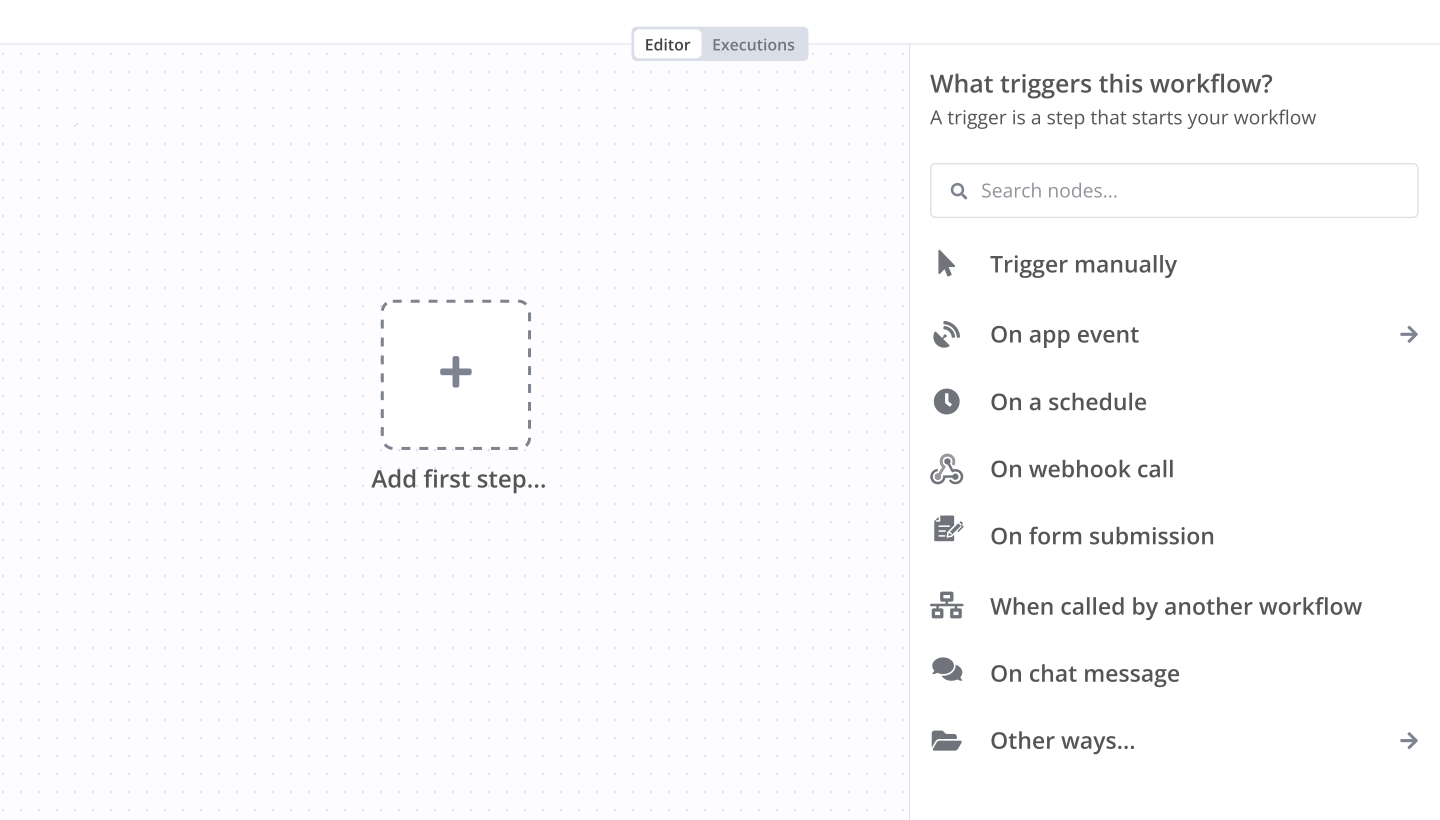
Microsoft Outlook and Notion integration: Create a new workflow and add the first step

Step 2: Add and configure Microsoft Outlook and Notion nodes

You can find Microsoft Outlook and Notion in the nodes panel. Drag them onto your workflow canvas, selecting their actions. Click each node, choose a credential, and authenticate to grant n8n access. Configure Microsoft Outlook and Notion nodes one by one: input data on the left, parameters in the middle, and output data on the right.

Microsoft Outlook and Notion integration: Add and configure Microsoft Outlook and Notion nodes

Step 3: Connect Microsoft Outlook and Notion

A connection establishes a link between Microsoft Outlook and Notion (or vice versa) to route data through the workflow. Data flows from the output of one node to the input of another. You can have single or multiple connections for each node.

Microsoft Outlook and Notion integration: Connect Microsoft Outlook and Notion

Step 4: Customize and extend your Microsoft Outlook and Notion integration

Use n8n's core nodes such as If, Split Out, Merge, and others to transform and manipulate data. Write custom JavaScript or Python in the Code node and run it as a step in your workflow. Connect Microsoft Outlook and Notion with any of n8n’s 1000+ integrations, and incorporate advanced AI logic into your workflows.

Microsoft Outlook and Notion integration: Customize and extend your Microsoft Outlook and Notion integration

Step 5: Test and activate your Microsoft Outlook and Notion workflow

Save and run the workflow to see if everything works as expected. Based on your configuration, data should flow from Microsoft Outlook to Notion or vice versa. Easily debug your workflow: you can check past executions to isolate and fix the mistake. Once you've tested everything, make sure to save your workflow and activate it.

Microsoft Outlook and Notion integration: Test and activate your Microsoft Outlook and Notion workflow

Gumroad Clientbell: Auto-log sales, ping Telegram, & thank via email

Who is this for?
This template is perfect for Gumroad creators, solopreneurs, digital product sellers, and freelancers who want to track and thank customers automatically — without spending time on manual work.

What problem does this solve?
Every sale is a moment to build trust. But manually checking your inbox for new orders, logging clients, and remembering to send a thank-you note? It’s time-consuming and inconsistent.

This workflow handles it all:
From sale → to sheet → to ping → to personalized “thank you” — all fully automated.

What this workflow does:
✅ Triggers on each new sale on Gumroad
📋 Extracts buyer details, amount paid, and product purchased
📈 Logs the sale to a Google Sheet for tracking
📲 Sends a Telegram approval message to notify you
💌 (Optional) Sends a Gmail thank-you email to the buyer
🔁 Keeps your workflow organized with color-coded notes and sample data

⚙️ Setup Instructions:

Create Gumroad API and connect the trigger node
Authenticate with Google Sheets to store each client
Connect your Telegram bot for real-time alerts
(Optional) Setup Gmail API for sending thank-you emails
Customize the email copy & sheet headers (e.g. % cut, timestamps)

🗒 Color-coded workflow notes:

To make customization smooth, the workflow includes a color-coded sticky note system:

🟩 Green Notes – Main building blocks (trigger, logging, ping, email)
🟦 Blue Notes – Setup guidance and editable fields (e.g. your email or brand name)
🟨 Yellow Notes – Optional upgrades (e.g. swap Gmail, use AI email generator, change to WhatsApp)

Each step has comments or hints to make your setup easy — whether you're new to n8n or a seasoned automator.

🔧 How to customize this workflow?

🎯 Swap Gmail with Outlook, SMTP, or Mailgun
🤖 Use AI (e.g. OpenAI or Claude) to draft personalized emails dynamically
📞 Replace Telegram with WhatsApp, Discord, or Slack
🗃️ Log to Airtable or Notion instead of Google Sheets
🧠 Add approval logic or advanced tagging in Gmail

🧾 Licensing & Support

This template is built by Velebit from Innovatio. External links (Gumroad store or support email) are included in the notes for optional help and upgrades.

A separate license applies to the paid version on Gumroad, which includes additional modules and commercial use rights.

📩 Support & customization: [email protected]

Nodes used in this workflow

Popular Microsoft Outlook and Notion workflows

+5

Gumroad Clientbell: Auto-Log Sales, Ping Telegram, & Thank via Email

Who is this for? This template is perfect for Gumroad creators, solopreneurs, digital product sellers, and freelancers who want to track and thank customers automatically — without spending time on manual work. What problem does this solve? Every sale is a moment to build trust. But manually checking your inbox for new orders, logging clients, and remembering to send a thank-you note? It’s time-consuming and inconsistent. This workflow handles it all: From sale → to sheet → to ping → to personalized “thank you” — all fully automated. What this workflow does: ✅ Triggers on each new sale on Gumroad 📋 Extracts buyer details, amount paid, and product purchased 📈 Logs the sale to a Google Sheet for tracking 📲 Sends a Telegram approval message to notify you 💌 (Optional) Sends a Gmail thank-you email to the buyer 🔁 Keeps your workflow organized with color-coded notes and sample data ⚙️ Setup Instructions: Create Gumroad API and connect the trigger node Authenticate with Google Sheets to store each client Connect your Telegram bot for real-time alerts (Optional) Setup Gmail API for sending thank-you emails Customize the email copy & sheet headers (e.g. % cut, timestamps) 🗒 Color-coded workflow notes: To make customization smooth, the workflow includes a color-coded sticky note system: 🟩 Green Notes – Main building blocks (trigger, logging, ping, email) 🟦 Blue Notes – Setup guidance and editable fields (e.g. your email or brand name) 🟨 Yellow Notes – Optional upgrades (e.g. swap Gmail, use AI email generator, change to WhatsApp) Each step has comments or hints to make your setup easy — whether you're new to n8n or a seasoned automator. 🔧 How to customize this workflow? 🎯 Swap Gmail with Outlook, SMTP, or Mailgun 🤖 Use AI (e.g. OpenAI or Claude) to draft personalized emails dynamically 📞 Replace Telegram with WhatsApp, Discord, or Slack 🗃️ Log to Airtable or Notion instead of Google Sheets 🧠 Add approval logic or advanced tagging in Gmail 🧾 Licensing & Support This template is built by Velebit from Innovatio. External links (Gumroad store or support email) are included in the notes for optional help and upgrades. A separate license applies to the paid version on Gumroad, which includes additional modules and commercial use rights. 📩 Support & customization: [email protected]
+4

Build AI-Ready Knowledge Base from Outlook & Notion using Pinecone & GPT-4

Outlook & Notion Knowledge Base Builder for AI Agents This n8n template lets you automatically build and maintain an AI-ready knowledge base from Outlook emails and Notion pages. It stores both sources in a Pinecone vector database so your AI agent can reference them when generating answers, extracting information, or drafting context-aware emails. Who’s it for Teams using Outlook for client or customer communications. Businesses maintaining documentation or notes in Notion. Developers or AI builders who want to create custom knowledge bases for intelligent agents. How it works / What it does Outlook Integration: When you move an email or thread to a specific folder (e.g., “knowledgebase”), the workflow triggers automatically. It captures the entire conversation, removes duplicates, and stores it in Pinecone under a namespace called "emails". The AI agent later uses these stored emails to learn tone, structure, and context for drafting responses. Notion Integration: When a page is added to a designated Notion database, the workflow triggers. The page content is extracted and embedded into Pinecone under the "knowledgebase" namespace. This allows your agent to use your Notion pages as factual reference material when answering questions. AI Agent Setup: Uses two Pinecone tools — one to reference Notion content (knowledge base) and another for emails (style & tone). Equipped with Cohere embeddings for multilingual support and OpenAI for conversation or drafting tasks. When queried, the agent retrieves relevant knowledge from both namespaces to produce accurate, context-rich replies. How to set up Import this template into your n8n account. Connect your Outlook account and specify which folder to watch (e.g., “knowledgebase”). Connect your Notion account and select your target database. Connect your Pinecone, Cohere, and OpenAI credentials. Activate the workflow — new Notion pages and Outlook threads will automatically update your knowledge base. Requirements n8n account. Microsoft Outlook account. Notion account and database. Pinecone account for vector storage. Cohere API key for embeddings. OpenAI API key for AI model. How to customize the workflow Namespaces:** Rename or expand namespaces (e.g., “sales_emails”, “internal_docs”) to organize knowledge types. Embeddings Model:** Replace Cohere with OpenAI embeddings if preferred. Agent Behavior:** Adjust the agent’s system message to change its tone or purpose (e.g., “act as a sales assistant”). Extra Sources:** Extend this workflow to include PDFs, websites, or Slack messages. Sync Schedule:** Modify trigger intervals to control how frequently updates are captured. This workflow automatically builds a living, AI-powered knowledge base from your Outlook and Notion data — perfect for intelligent support, research, or content generation.

Build your own Microsoft Outlook and Notion integration

Create custom Microsoft Outlook and Notion workflows by choosing triggers and actions. Nodes come with global operations and settings, as well as app-specific parameters that can be configured. You can also use the HTTP Request node to query data from any app or service with a REST API.

Microsoft Outlook supported actions

Create
Create a new calendar
Delete
Delete a calendar
Get
Retrieve a calendar
Get Many
List and search calendars
Update
Update a calendar
Create
Create a new contact
Delete
Delete a contact
Get
Retrieve a contact
Get Many
List and search contacts
Update
Update a contact
Create
Create a new email draft
Delete
Delete an email draft
Get
Retrieve an email draft
Send
Send an existing email draft
Update
Update an email draft
Create
Create a new event
Delete
Delete an event
Get
Retrieve an event
Get Many
List and search events
Update
Update an event
Create
Create a mail folder in the root folder of the user's mailbox
Delete
Delete a folder
Get
Retrieve a folder
Get Many
Get many folders
Update
Update a folder
Get Many
Retrieves the messages in a folder
Delete
Delete a message
Get
Retrieve a single message
Get Many
List and search messages
Move
Move a message to a folder
Reply
Create a reply to a message
Send
Send a message
Send and Wait for Response
Send a message and wait for response
Update
Update a message
Add
Add an attachment to a message
Download
Download an attachment from a message
Get
Retrieve information about an attachment of a message
Get Many
Retrieve information about the attachments of a message

Notion supported actions

Append After
Append a block
Get Child Blocks
Get many child blocks
Get
Get a database
Get Many
Get many databases
Search
Search databases using text search
Get
Get a database
Get Many
Get many databases
Create
Create a page in a database
Get
Get a page in a database
Get Many
Get many pages in a database
Update
Update pages in a database
Create
Create a pages in a database
Get Many
Get many pages in a database
Update
Update pages in a database
Create
Create a page
Get
Get a page
Search
Text search of pages
Archive
Archive a page
Create
Create a page
Search
Text search of pages
Get
Get a user
Get Many
Get many users

FAQs

  • Can Microsoft Outlook connect with Notion?

  • Can I use Microsoft Outlook’s API with n8n?

  • Can I use Notion’s API with n8n?

  • Is n8n secure for integrating Microsoft Outlook and Notion?

  • How to get started with Microsoft Outlook and Notion integration in n8n.io?

Need help setting up your Microsoft Outlook and Notion integration?

Discover our latest community's recommendations and join the discussions about Microsoft Outlook and Notion integration.
Justin Cheu
Cris A. Works
Martin
Liam Skaff
AyS 0908

Looking to integrate Microsoft Outlook and Notion in your company?

Over 3000 companies switch to n8n every single week

Why use n8n to integrate Microsoft Outlook with Notion

Build complex workflows, really fast

Build complex workflows, really fast

Handle branching, merging and iteration easily.
Pause your workflow to wait for external events.

Code when you need it, UI when you don't

Simple debugging

Your data is displayed alongside your settings, making edge cases easy to track down.

Use templates to get started fast

Use 1000+ workflow templates available from our core team and our community.

Reuse your work

Copy and paste, easily import and export workflows.

Implement complex processes faster with n8n

red iconyellow iconred iconyellow icon