Back to Integrations
integrationSlack node
integrationSupabase node

Slack and Supabase integration

Save yourself the work of writing custom integrations for Slack and Supabase and use n8n instead. Build adaptable and scalable Communication, HITL, and Data & Storage workflows that work with your technology stack. All within a building experience you will love.

How to connect Slack and Supabase

  • Step 1: Create a new workflow
  • Step 2: Add and configure nodes
  • Step 3: Connect
  • Step 4: Customize and extend your integration
  • Step 5: Test and activate your workflow

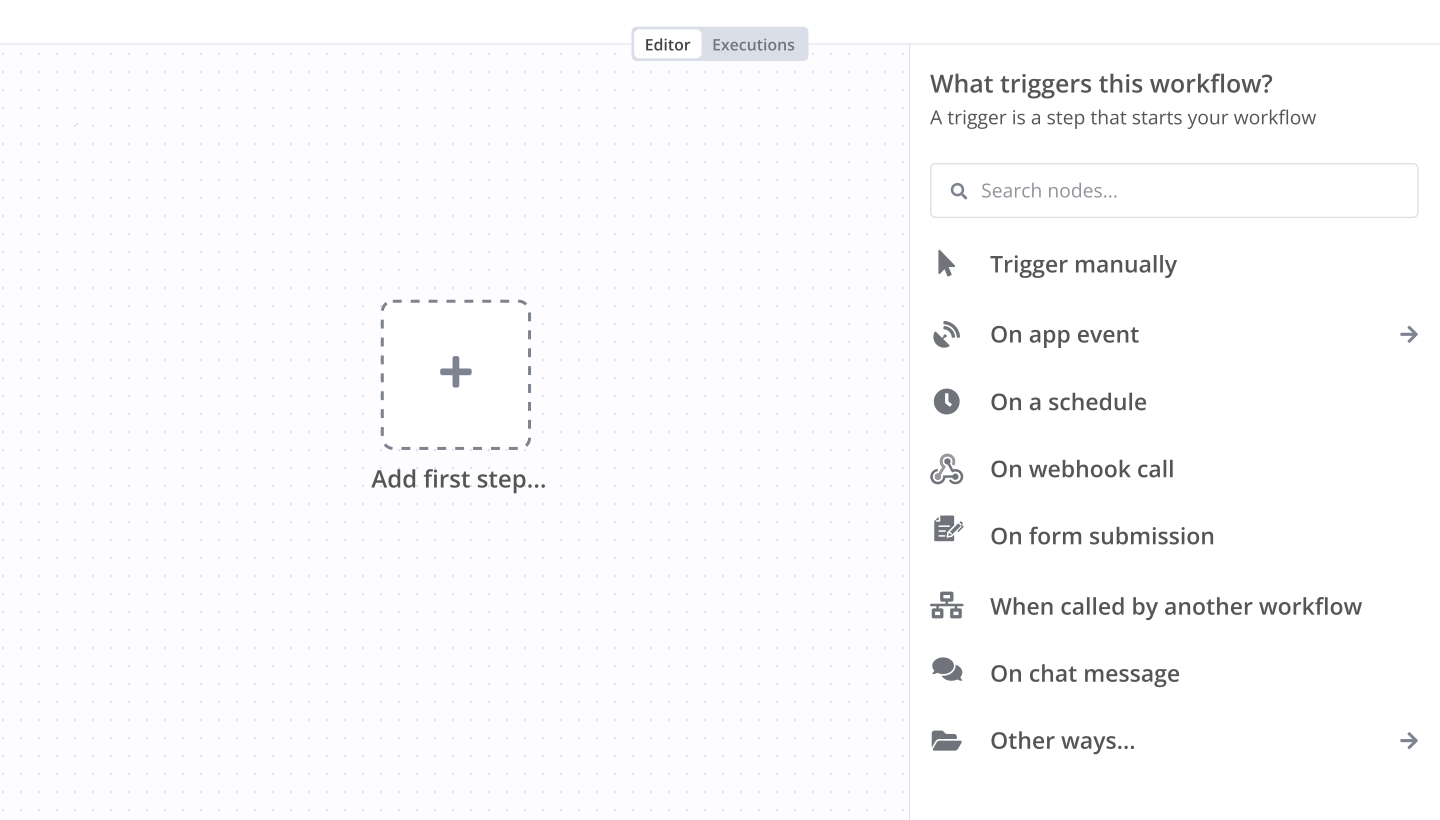
Step 1: Create a new workflow and add the first step

In n8n, click the "Add workflow" button in the Workflows tab to create a new workflow. Add the starting point – a trigger on when your workflow should run: an app event, a schedule, a webhook call, another workflow, an AI chat, or a manual trigger. Sometimes, the HTTP Request node might already serve as your starting point.

Slack and Supabase integration: Create a new workflow and add the first step

Step 2: Add and configure Slack and Supabase nodes

You can find Slack and Supabase in the nodes panel. Drag them onto your workflow canvas, selecting their actions. Click each node, choose a credential, and authenticate to grant n8n access. Configure Slack and Supabase nodes one by one: input data on the left, parameters in the middle, and output data on the right.

Slack and Supabase integration: Add and configure Slack and Supabase nodes

Step 3: Connect Slack and Supabase

A connection establishes a link between Slack and Supabase (or vice versa) to route data through the workflow. Data flows from the output of one node to the input of another. You can have single or multiple connections for each node.

Slack and Supabase integration: Connect Slack and Supabase

Step 4: Customize and extend your Slack and Supabase integration

Use n8n's core nodes such as If, Split Out, Merge, and others to transform and manipulate data. Write custom JavaScript or Python in the Code node and run it as a step in your workflow. Connect Slack and Supabase with any of n8n’s 1000+ integrations, and incorporate advanced AI logic into your workflows.

Slack and Supabase integration: Customize and extend your Slack and Supabase integration

Step 5: Test and activate your Slack and Supabase workflow

Save and run the workflow to see if everything works as expected. Based on your configuration, data should flow from Slack to Supabase or vice versa. Easily debug your workflow: you can check past executions to isolate and fix the mistake. Once you've tested everything, make sure to save your workflow and activate it.

Slack and Supabase integration: Test and activate your Slack and Supabase workflow

Generate and send AI-powered sales quotes with Gmail, OpenAI and Supabase

An automated quote generation system that monitors your inbox, classifies quote requests using AI, calculates intelligent pricing based on historical data, and provides a professional dashboard for review and sending quotes with one click.

https://github.com/nickpuru/proposal-generation

Nodes used in this workflow

Popular Slack and Supabase workflows

Qualify and book Facebook leads with ElevenLabs voice calls, Cal, Supabase, Slack and Gmail

How it Works As soon as a new lead fills out your form through facebook ads, the data gets sent to n8n immediately and saved to Supabase. Then an outbound call gets triggered instantly to qualify the lead and book a meeting if applicable. As soon as this step is completed, a slack and email notification is sent to the team Set up steps download and import workflow into n8n Add credentials for Facebook, Eleven Labs, Cal, Supabase, Slack and Gmail Run workflow node by node and edit accordingly Requirements Facebook Account: Includes facebook ads account, business page, Facebook leads form Eleven Labs Account Cal Account Supabase Account Slack Account Gmail Account Who this is for This is for any business running facebook ads and wants to qualify leads and book appointment with qualified leads using voice agents.

Handle retail payment failures with retry emails, Slack alerts and Supabase logging

Retail Payment Failure Alerts with Retry Emails, Slack & Supabase This n8n workflow automatically handles failed payment events from payment gateways such as Stripe, Shopify, PayPal or WooCommerce. It receives payment failure webhooks, standardizes the incoming data, identifies the reason for failure and classifies each case into: Soft Failure** (temporary / retryable) Hard Failure** (permanent / non-retryable) Fraudulent Failure** (high-risk / suspicious) Based on the classification, the workflow automatically: Sends internal Slack alerts Emails customers to retry failed payments Applies retry limits with wait delays Flags fraud cases instantly Stores all payment failures in Supabase It helps businesses recover lost revenue, reduce manual payment support work and detect suspicious transactions early. Quick Implementation Steps Import this JSON workflow into your n8n account. Connect your payment provider webhook endpoint. Add Slack API credentials. Add Gmail credentials for customer retry emails. Add Supabase credentials for failure logging. Enable the workflow — done! What It Does Receives Payment Failure Events Accepts POST webhook requests when a payment fails. Supports providers such as Stripe, Shopify, PayPal, WooCommerce or custom gateways. Normalizes Payment Data Extracts consistent fields such as: order_id customer_email customer_name order_value currency failure_reason retry_url Classifies Failure Type Soft Failure → insufficient funds, timeout, temporary processor issues Hard Failure → expired card, invalid card, permanent decline Fraud Failure → stolen card, restricted card, suspicious activity Soft Failure Recovery Flow Sends Slack alert to internal team Checks if order is high-value Sends retry email to customer Waits before next retry Counts retry attempts Stops after retry limit Hard Failure Handling Sends internal Slack notification Logs failure for support / reporting Fraud Handling Sends urgent Slack fraud alert Prevents retry flow Logs suspicious payment event Supabase Logging Stores all failures with timestamp, customer email, retry count, order value, status and reason. Who It's For This workflow is ideal for: Ecommerce stores handling online payments Subscription SaaS businesses Finance and billing teams Operations teams reducing payment support workload Businesses wanting failed payment recovery automation Teams using Slack + Gmail + Supabase + n8n Requirements n8n account (Self-Hosted or Cloud) Payment provider capable of sending webhooks Slack Bot credentials Gmail OAuth credentials Supabase account + database table Basic understanding of payment failure events How It Works Webhook Trigger Workflow starts when a payment failure event is sent to the webhook endpoint. Normalize Data Extracts payment details from webhook payload. Converts provider-specific fields into a unified structure. Failure Detection Logic Function node checks decline codes and error messages. Categorizes failure into: soft hard fraud Routing Soft failures go to retry recovery flow. Fraud and hard failures go to separate alerting branches. Retry Recovery Slack notification sent. High-value order check performed. Customer receives retry payment email. Wait timer delays repeated reminders. Retry count increases. Stops after 3 attempts. Fraud Handling Immediate Slack fraud alert. Logs case in database. Hard Failure Handling Team notified. Case logged in database. Database Logging All outcomes saved into Supabase. Setup Instructions Import Workflow → Workflows → Import from File in n8n. Webhook Setup → copy URL from Receive Payment Failure node. Payment Gateway Setup → configure Stripe / Shopify / PayPal webhook to send failed payment events. Slack Credentials → connect Slack account and choose alert channel. Gmail Credentials → connect Gmail account for customer notifications. Supabase Setup → connect Supabase and create payment_failure table. Configure Thresholds High-value order threshold = 500 Retry limit = 3 Wait delay = 2 minutes Test Workflow using sample failed payments. Enable Workflow once validated. Logic Overview | Step | Node | Description | |---|---|---| | 1 | Webhook Trigger | Starts workflow on failed payment webhook | | 2 | Normalize Data | Creates standard payment fields | | 3 | Classify Failure | Detects soft, hard or fraud | | 4 | Route by Type | Branches logic by failure category | | 5 | Soft Alert | Sends internal Slack notification | | 6 | High Value Check | Checks order amount ≥ threshold | | 7 | Customer Retry Email | Emails payment retry link | | 8 | Delay | Prevents excessive reminders | | 9 | Increase Counter | Tracks retry attempts | | 10 | Limit Check | Stops after max retries | | 11 | Fraud Alert | Urgent suspicious payment alert | | 12 | Hard Failure Alert | Standard non-retryable alert | | 13 | Database Logging | Stores all results in Supabase | Customization Options Webhook Node** → change endpoint path. Failure Detection Logic** → add new decline codes from your payment provider. Retry Limits** → increase or decrease retry attempts. Wait Node** → modify delay between reminders. High Value Threshold** → change 500 to your preferred value. Slack Nodes** → route alerts by severity or department. Email Template** → customize customer retry message. Supabase Table** → add columns like gateway, country, payment method. Optional Enhancements SMS payment retry reminders Auto-create CRM support tickets Dashboard reporting Customer segmentation by payment risk AI fraud scoring Revenue recovery analytics Retry using alternate payment gateway Use Case Examples Recover failed subscription renewals automatically. Detect stolen card attempts in real time. Notify customers when cards have insufficient funds. Reduce abandoned orders caused by temporary payment issues. Track failed payment trends across gateways. Alert finance teams for high-value payment failures. Troubleshooting Guide | Issue | Possible Cause | Solution | |---|---|---| | Workflow not receiving events | Webhook misconfigured | Verify webhook URL and provider settings | | Customer email not sent | Gmail credentials expired | Reconnect Gmail OAuth | | Slack alerts missing | Wrong channel ID or token | Update Slack credentials | | Soft failures not classified | Missing decline codes | Update Identify Failure Type logic | | Retry loop not stopping | Retry limit condition incorrect | Verify IF node logic | | Supabase insert fails | Wrong table/credentials | Check database schema and credentials | | Order value incorrect | Currency conversion issue | Review amount /100 logic | | Fraud cases not flagged | New fraud codes missing | Add provider fraud decline codes | Need Help? If you need help setting up, customizing or extending this workflow, WeblineIndia can assist with full n8n workflow development, payment automation, revenue recovery systems, fraud monitoring, Slack integrations and custom business process automation.

Track Facebook mention sentiment with Gemini, Supabase, Telegram and Slack

Facebook Mention Sentiment Tracker with Gemini, Supabase, Telegram & Slack This workflow automatically tracks Facebook page mentions, analyzes sentiment using AI (Gemini), stores the data in Supabase and sends alerts via Telegram and Slack. Positive mentions are shared on Telegram, while critical or negative mentions trigger Slack alerts for immediate attention. It also handles storage failures by notifying via Telegram. Quick Start (Implement in Minutes) Login to your n8n account. Connect your Facebook Page to the trigger node. Configure Gemini API credentials for sentiment analysis. Set up Supabase and create a mentions table. Add Telegram bot credentials for notifications. Connect Slack and choose a channel for alerts. Test with sample data and activate the workflow. What It Does This workflow listens for new Facebook Page mentions in real time. When a mention is received, it sends the message to an AI model (Gemini) to analyze sentiment (positive, neutral or negative) and extract the main topic. The response is cleaned and structured into a consistent JSON format for further processing. After processing, the workflow stores the mention data in Supabase for tracking and analytics. It then evaluates the sentiment and content of the message to determine the next action. Positive mentions are shared with your team via Telegram to highlight customer satisfaction. For risk management, the workflow detects critical keywords (like refund, bug, slow, cancel) and also checks if the sentiment is negative. If either condition is met, a Slack alert is triggered so your team can take immediate action. Additionally, if storing data in Supabase fails, a Telegram alert is sent to notify about the issue. Who It's For Social media managers monitoring brand mentions Customer support teams handling complaints Product teams tracking user feedback Startups and agencies managing multiple clients Businesses wanting real-time alerting on customer sentiment Requirements to Use This Workflow n8n account (self-hosted or cloud) Facebook Developer App with Page access Google Gemini API credentials Supabase account and project Telegram Bot Token & Chat ID(s) Slack workspace with API access Basic understanding of n8n nodes and credentials How It Works The workflow starts when a new Facebook mention is detected. The message is sent to Gemini AI for sentiment and topic analysis. The AI response is cleaned and normalized into structured JSON. The processed data is stored in Supabase. If sentiment is positive → Telegram notification is sent. Keywords are checked to detect critical intent. If sentiment is negative OR keywords match → Slack alert is triggered. If Supabase storage fails → Telegram error alert is sent. Setup Instructions Facebook Trigger Configure Facebook App ID. Enable webhook for Page mentions. Ensure required permissions are granted. Gemini Node Add Google Gemini API credentials. Use any model (default: gemini-2.5-flash). Ensure output is structured JSON. Code Node (Clean AI Response) Keep existing logic to extract and normalize AI response. Supabase Node Create a mentions table. Add fields: message, sentiment, topic, user_name, created_time, confidence Connect using Supabase credentials. Telegram Nodes Add bot token. Use different chat IDs for: Positive mentions Error alerts (recommended) Slack Node Connect Slack workspace. Select a channel for critical alerts. IF Nodes Configure: Positive sentiment check Critical/negative condition routing Test Workflow Use mock or pinned data. Verify Telegram and Slack alerts. Activate workflow. How To Customize Nodes Gemini Node** Change model (e.g., advanced models for better accuracy) Modify prompt to extract more fields (intent, urgency, etc.) Keyword Detection** Update keywords array: ["refund", "cancel", "bug", "slow"] Add business-specific terms Slack संदेश** Customize alert format Add priority levels or tagging Telegram Messages** Adjust formatting (Markdown, emojis, structure) Supabase** Add more columns if needed (e.g., region, category) Add-ons (Extend This Workflow) Add sentiment trend dashboard (via Supabase + BI tools) Auto-create support tickets (Zendesk, Freshdesk) Email alerts for high-priority issues Auto-reply system for Facebook comments Weekly analytics report via email or Slack AI-based response suggestions for support team Use Case Examples Detect and respond instantly to refund complaints Monitor brand reputation across social media Highlight positive feedback for marketing teams Escalate urgent issues to internal teams via Slack Build a centralized database of customer feedback There can be many more use cases depending on your business needs. Troubleshooting Guide | Issue | Possible Cause | Solution | | ------------------------- | ---------------------------------- | -------------------------------- | | No Facebook data | Webhook not configured | Check Facebook App & permissions | | AI not returning data | Incorrect prompt or API issue | Verify Gemini configuration | | Supabase insert fails | गलत credentials or schema mismatch | Check table structure & API key | | Telegram not sending | Wrong bot token or chat ID | Verify credentials | | Slack alert not triggered | Condition mismatch | Check IF node logic | | Keywords not detected | Case mismatch or logic error | Ensure .toLowerCase() is used | Need Help? If you need help setting up this workflow or want to extend it with advanced features like automation, dashboards or integrations then our n8n workflow development team at WeblineIndia can assist you. We can help you: Customize this workflow for your business Integrate additional tools (CRM, Helpdesk, Analytics) Build scalable automation systems using n8n Reach out to WeblineIndia to get started with tailored automation solutions.

Capture, score and route Gmail leads with Groq Llama 3.3, Supabase and Slack

How it works This workflow captures incoming leads from Gmail, validates and stores them in Supabase, then uses AI to score and classify each lead. Based on the classification, leads are automatically routed to the appropriate Slack channel. It runs continuously with a wait cycle to process new and updated leads. The result is a fully automated lead qualification and routing system. Step-by-step Lead capture and validation** Gmail Trigger – Monitors inbox for new lead emails. Get a message – Retrieves full email content. Normalize Incoming Lead Data – Extracts name, message, email, and source. Validate Lead Data – Ensures required fields are present. Lead storage and notification** Notify New Lead (Slack) – Sends alert to Slack channel. Store Lead in Database – Saves lead data in Supabase. AI lead scoring pipeline** Wait – Delays execution before next cycle. Fetch Unscored Leads – Retrieves leads with score = 0. AI Lead Scoring Engine – Generates score and summary. LLM (Scoring) – Provides AI model for scoring. Structured Output Parser – Formats AI response. Map AI Score Output – Prepares score data fields. Update Lead Score – Updates score and status in database. Lead qualification and classification** Fetch Scored Leads – Gets leads ready for routing. Check Message Exists – Filters valid messages. AI Lead Classification Engine – Categorizes lead type. LLM (Classification) – Provides classification logic. Smart routing and notifications** Route Lead by Category – Splits leads by category. Send to Sales Channel – Sends sales leads to Slack. Send to Support Channel – Sends support leads. Send to Billing Channel – Sends billing-related leads. End – Stops workflow for unmatched cases. Why use this? Automatically prioritizes high-quality leads using AI scoring Eliminates manual lead sorting and routing effort Ensures faster response by notifying the right team instantly Centralizes lead data in a structured database Scales easily for high-volume inbound lead processing

Monitor WooCommerce inventory daily and send Slack alerts with Supabase

Daily Inventory Monitoring & Reorder System This workflow automatically monitors your WooCommerce store inventory, calculates stock health based on recent sales, classifies products, computes reorder quantities, assigns urgency levels and sends actionable alerts to Slack. This workflow runs daily to track your inventory and prevent stock issues. It fetches all active products and recent completed orders, calculates units sold in the last 30 days, evaluates stock health, and classifies products as Top Performer, Steady, At Risk, or Consider Discontinue. You receive: Daily inventory check (automated)** Database record of each product’s stock and recommended action** Slack alerts for urgent items and a daily summary** Ideal for teams wanting simple, automated visibility of inventory without manually reviewing stock levels. Quick Start – Implementation Steps Connect your WooCommerce account (products and orders). Connect Supabase to store inventory records. Connect Slack to receive alerts and daily summaries. Set the schedule time for daily checks. Review and adjust stock thresholds (lead time, safety days) if needed. Activate the workflow — daily inventory monitoring begins automatically. What It Does This workflow automates inventory monitoring: Fetches all published products from WooCommerce with current stock. Retrieves completed orders from the last 30 days to calculate sales. Calculates units sold per product and estimates average daily demand. Merges product and sales data for stock evaluation. Classifies products based on stock and demand: Top Performer Steady At Risk Consider Discontinue Calculates safety stock, reorder points, and reorder quantities. Assigns urgency levels (Normal, High, Critical) with clear action messages. Sends Slack alerts for high-priority products. Saves all inventory data into Supabase for tracking. Builds and sends a daily summary with totals, at-risk products, and reorder needs. This ensures your team always knows stock status and can act quickly to prevent shortages. Who’s It For This workflow is ideal for: Inventory managers Operations teams E-commerce teams Supply chain planners Anyone needing automated stock monitoring and alerts Requirements to Use This Workflow To run this workflow, you need: n8n instance** (cloud or self-hosted) WooCommerce API credentials** (products & orders) Supabase account** (database for inventory tracking) Slack workspace** with API permissions Basic understanding of inventory management and reorder logic How It Works Daily Check – Workflow triggers automatically at the scheduled time. Fetch Products & Orders – Gets all published products and completed orders from the last 30 days. Calculate Sales & Demand – Determines units sold and average daily demand per product. Merge Data – Combines stock data with sales to evaluate inventory health. Inventory Classification – Categorizes products as Top Performer, Steady, At Risk, or Consider Discontinue. Reorder Calculations – Computes safety stock, reorder point, and recommended reorder quantity. Assign Urgency & Actions – Flags products as Normal, High, or Critical and sets clear action messages. Immediate Action Check – Identifies high-priority products that need urgent attention. Save to Database – Stores inventory status and recommendations in Supabase. Daily Summary – Builds summary and sends Slack notifications for overall stock health. Setup Steps Import the provided n8n JSON workflow. Connect your WooCommerce account (products and orders). Connect Supabase account and configure the table for inventory tracking. Connect Slack and select channels for urgent alerts and daily summary. Adjust lead time, safety stock days, and any thresholds if needed. Activate the workflow — daily automated inventory monitoring and reporting begins. How To Customize Nodes Customize Reorder Calculations Adjust safety stock days, lead time, or reorder formulas in the Reorder Calculator node. Customize Urgency & Actions Modify logic in the Urgency & Recommendation node to change thresholds or messaging. Customize Slack Alerts You can change: Slack channel Message format Include emojis or tags Customize Database Storage Add extra fields in Supabase to store more product information if needed. Add-Ons (Optional Enhancements) You can extend this workflow to: Track multiple warehouses Send alerts only for specific categories Generate weekly inventory reports Include stock valuation or cost metrics Integrate with other communication channels (email, Teams) Use Case Examples Daily Inventory Check Automatically tracks stock levels for all products. Urgent Stock Alerts Notifies the team immediately when items are At Risk or need reorder. Reporting & Tracking Keeps a historical record of stock health in the database. Troubleshooting Guide | Issue | Possible Cause | Solution | |-------|----------------|---------| | Slack alerts not sent | Invalid credentials | Update Slack API key | | Supabase row not saved | Wrong table/field mapping | Check table and field names | | Wrong stock classification | Thresholds incorrect | Adjust lead time, safety days, or demand calculation | | Workflow not running | Schedule not active | Enable Schedule Trigger node | Need Help? If you need help in customizing or extending this workflow with multi-warehouse tracking, advanced alerts, dashboards or scaling, then our n8n automation developers at WeblineIndia will be happy to assist you.
+2

Flag duplicate and risky AP invoices with Gmail, OpenAI and Supabase

🚀 How it works Monitors your AP inbox for incoming invoices, extracts structured data with AI, runs duplicate and vendor history checks against Supabase, then scores each invoice for fraud risk — routing suspicious ones to Slack and your AP team before any payment is processed. 📬 Gmail Trigger monitors your accounts payable inbox in real time 🤖 AI Agent extracts invoice number, vendor, amount, currency, dates and line items into structured JSON — no manual data entry 🔍 Checks Supabase for duplicate invoice numbers already in the system 🏢 Checks vendor payment history — flags unknown vendors and amount deviations above 50% from the vendor's historical average 🧠 Second AI Agent scores fraud risk: low / medium / high / critical with specific fraud indicators and a recommended action 🚨 High/critical risk — posts a detailed Slack alert to #invoice-alerts and emails your AP manager with a hold notice 🗄️ Logs every processed invoice to Supabase with risk score and status 🛠️ Set up steps Estimated setup time: ~20 minutes Gmail Trigger — connect Gmail OAuth2; point it at your AP inbox OpenAI — connect OpenAI API credential (used by both AI Agent nodes) Supabase — connect Supabase API credential; create two tables: invoices (invoice_number, vendor_name, amount, status, risk_level, created_at) and vendors (vendor_name, avg_amount, total_invoices, flagged) Slack — connect Slack OAuth2; update the channel name #invoice-alerts Gmail (Send) — connect Gmail OAuth2; replace [email protected] Follow the sticky notes inside the workflow for per-node guidance 📋 Prerequisites Gmail account receiving invoices OpenAI API key (GPT-4o) Supabase project with invoices and vendors tables Slack workspace with an alerts channel Custom Workflow Request with Personal Dashboard [email protected] https://www.smartflowcraft.com/contact More free templates https://www.smartflowcraft.com/n8n-templates

Build your own Slack and Supabase integration

Create custom Slack and Supabase workflows by choosing triggers and actions. Nodes come with global operations and settings, as well as app-specific parameters that can be configured. You can also use the HTTP Request node to query data from any app or service with a REST API.

Slack supported actions

Archive
Archives a conversation
Close
Closes a direct message or multi-person direct message
Create
Initiates a public or private channel-based conversation
Get
Get information about a channel
Get Many
Get many channels in a Slack team
History
Get a conversation's history of messages and events
Invite
Invite a user to a channel
Join
Joins an existing conversation
Kick
Removes a user from a channel
Leave
Leaves a conversation
Member
List members of a conversation
Open
Opens or resumes a direct message or multi-person direct message
Rename
Renames a conversation
Replies
Get a thread of messages posted to a channel
Set Purpose
Sets the purpose for a conversation
Set Topic
Sets the topic for a conversation
Unarchive
Unarchives a conversation
Get
Get Many
Get & filters team files
Upload
Create or upload an existing file
Delete
Get Permalink
Search
Send
Send and Wait for Response
Update
Add
Adds a reaction to a message
Get
Get the reactions of a message
Remove
Remove a reaction of a message
Add
Add a star to an item
Delete
Delete a star from an item
Get Many
Get many stars of autenticated user
Get
Get information about a user
Get Many
Get a list of many users
Get User's Profile
Get a user's profile
Get User's Status
Get online status of a user
Update User's Profile
Update a user's profile
Add Users
Create
Disable
Enable
Get Many
Get Users
Update

Supabase supported actions

Create
Create a new row
Delete
Delete a row
Get
Get a row
Get Many
Get many rows
Update
Update a row

FAQs

  • Can Slack connect with Supabase?

  • Can I use Slack’s API with n8n?

  • Can I use Supabase’s API with n8n?

  • Is n8n secure for integrating Slack and Supabase?

  • How to get started with Slack and Supabase integration in n8n.io?

Need help setting up your Slack and Supabase integration?

Discover our latest community's recommendations and join the discussions about Slack and Supabase integration.
Nicolas N
Muhammed Iqbal P B
Nicolas N

Looking to integrate Slack and Supabase in your company?

Over 3000 companies switch to n8n every single week

Why use n8n to integrate Slack with Supabase

Build complex workflows, really fast

Build complex workflows, really fast

Handle branching, merging and iteration easily.
Pause your workflow to wait for external events.

Code when you need it, UI when you don't

Simple debugging

Your data is displayed alongside your settings, making edge cases easy to track down.

Use templates to get started fast

Use 1000+ workflow templates available from our core team and our community.

Reuse your work

Copy and paste, easily import and export workflows.

Implement complex processes faster with n8n

red iconyellow iconred iconyellow icon