Back to Integrations
integrationWebhook node
integrationSalesforce node

Webhook and Salesforce integration

Save yourself the work of writing custom integrations for Webhook and Salesforce and use n8n instead. Build adaptable and scalable Development, Core Nodes, Sales, and Communication workflows that work with your technology stack. All within a building experience you will love.

How to connect Webhook and Salesforce

  • Step 1: Create a new workflow
  • Step 2: Add and configure nodes
  • Step 3: Connect
  • Step 4: Customize and extend your integration
  • Step 5: Test and activate your workflow

Step 1: Create a new workflow and add the first step

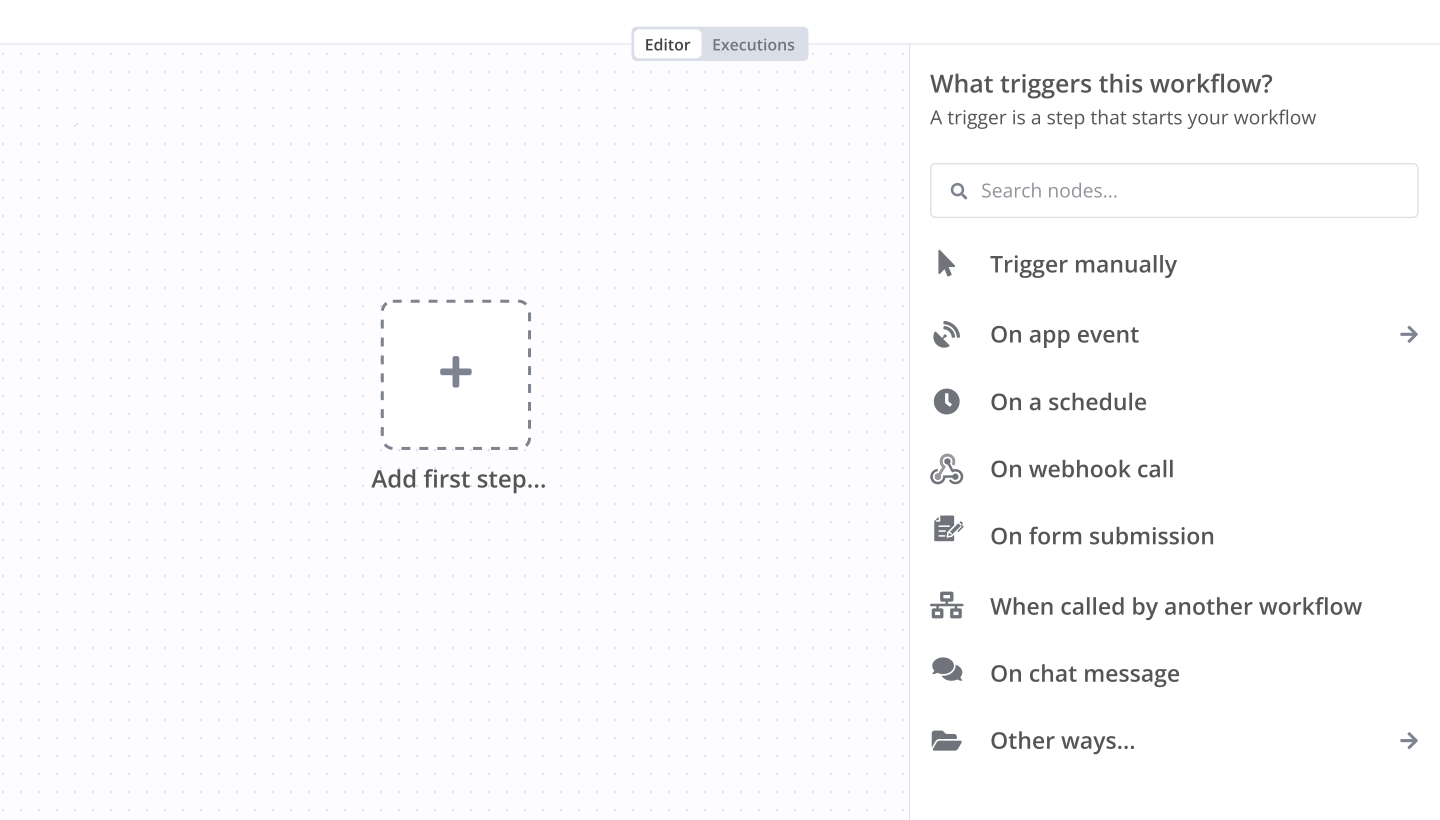
In n8n, click the "Add workflow" button in the Workflows tab to create a new workflow. Add the starting point – a trigger on when your workflow should run: an app event, a schedule, a webhook call, another workflow, an AI chat, or a manual trigger. Sometimes, the HTTP Request node might already serve as your starting point.

Webhook and Salesforce integration: Create a new workflow and add the first step

Step 2: Add and configure Webhook and Salesforce nodes

You can find Webhook and Salesforce in the nodes panel. Drag them onto your workflow canvas, selecting their actions. Click each node, choose a credential, and authenticate to grant n8n access. Configure Webhook and Salesforce nodes one by one: input data on the left, parameters in the middle, and output data on the right.

Webhook and Salesforce integration: Add and configure Webhook and Salesforce nodes

Step 3: Connect Webhook and Salesforce

A connection establishes a link between Webhook and Salesforce (or vice versa) to route data through the workflow. Data flows from the output of one node to the input of another. You can have single or multiple connections for each node.

Webhook and Salesforce integration: Connect Webhook and Salesforce

Step 4: Customize and extend your Webhook and Salesforce integration

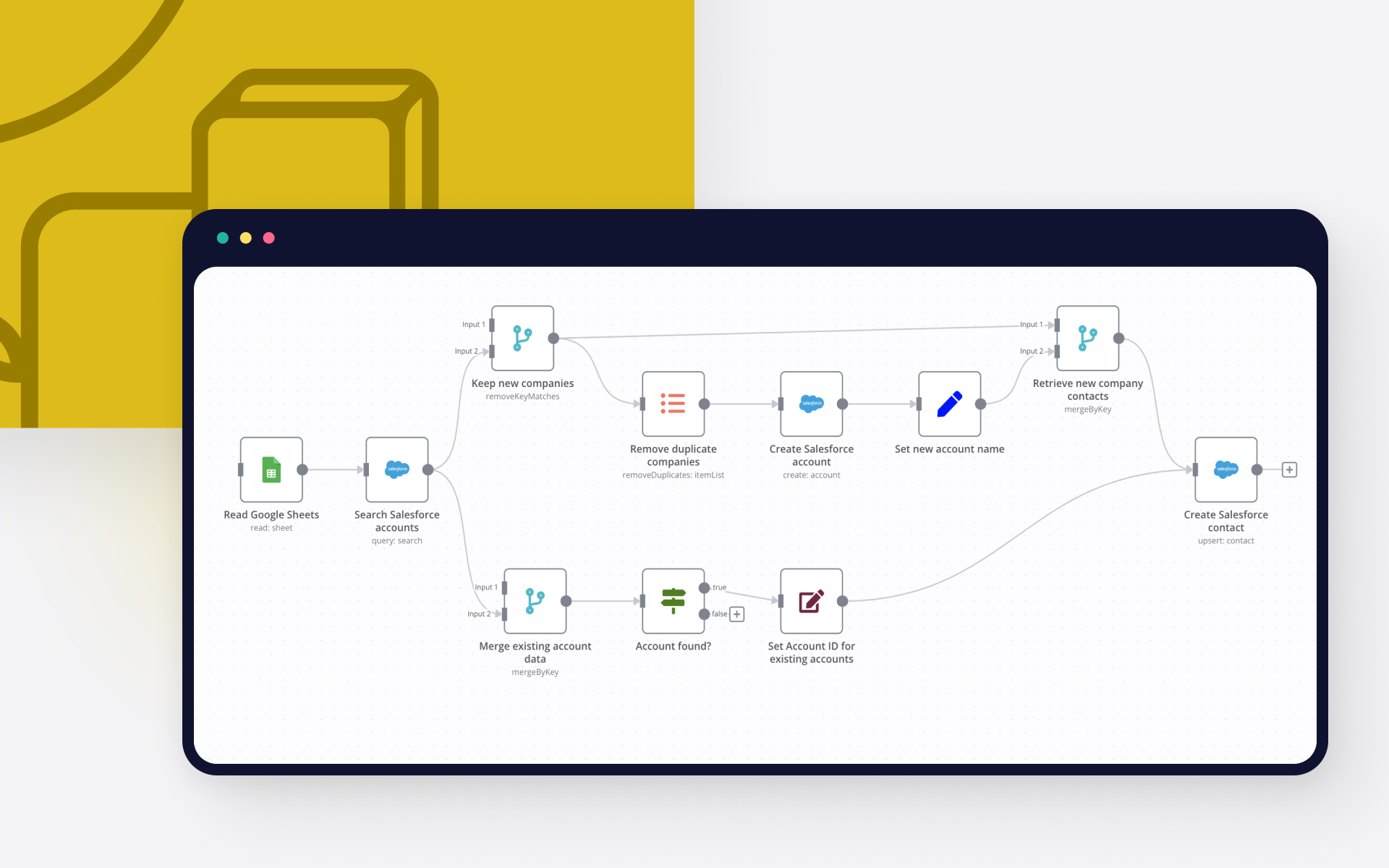
Use n8n's core nodes such as If, Split Out, Merge, and others to transform and manipulate data. Write custom JavaScript or Python in the Code node and run it as a step in your workflow. Connect Webhook and Salesforce with any of n8n’s 1000+ integrations, and incorporate advanced AI logic into your workflows.

Webhook and Salesforce integration: Customize and extend your Webhook and Salesforce integration

Step 5: Test and activate your Webhook and Salesforce workflow

Save and run the workflow to see if everything works as expected. Based on your configuration, data should flow from Webhook to Salesforce or vice versa. Easily debug your workflow: you can check past executions to isolate and fix the mistake. Once you've tested everything, make sure to save your workflow and activate it.

Webhook and Salesforce integration: Test and activate your Webhook and Salesforce workflow

Auto-create Geotab zone for new Salesforce work order

📝 DESCRIPTION OF THE WORKFLOW

This workflow connects Salesforce and Geotab to streamline fleet tracking for field service jobs (Work Orders). When a new Work Order is created in Salesforce (with a 'New' status and valid coordinates), it creates a circular geofence zone in Geotab and updates the Work Order with the zone ID. If geolocation is missing, an alert email is sent to dedicated email.

The workflow uses a Salesforce Outbound Message to trigger an n8n webhook. It includes robust credential handling and optional logic to skip or notify on bad data.

Use Cases:

Automating vehicle geofence setup for service visits
Enhancing CRM-to-fleet system synchronisation
Enforcing work orders data quality via alerts

Integrations Used:

Salesforce
Geotab API
Microsoft Outlook (or any SMTP-compatible service)

Tags:
geotab, salesforce, fleet management, gps tracking, field service, crm, automation, webhook, integration

ADDITIONAL RESOURCES
🔗 Salesforce

Salesforce Login
[Salesforce Setup (Admin Console)](https://login.salesforce.com/ → click “Setup” gear icon)
Outbound Messages Documentation
Salesforce Developer Documentation
Salesforce Workbench (API Testing Tool)

🔗 Geotab

Geotab Login (MyGeotab)
Geotab Developer Portal
Geotab API Explorer
Geotab SDK (JavaScript Samples)
Geotab Support Centre

Nodes used in this workflow

Popular Webhook and Salesforce workflows

Auto-Create Geotab Zone for New Salesforce Work Order

📝 DESCRIPTION OF THE WORKFLOW This workflow connects Salesforce and Geotab to streamline fleet tracking for field service jobs (Work Orders). When a new Work Order is created in Salesforce (with a 'New' status and valid coordinates), it creates a circular geofence zone in Geotab and updates the Work Order with the zone ID. If geolocation is missing, an alert email is sent to dedicated email. The workflow uses a Salesforce Outbound Message to trigger an n8n webhook. It includes robust credential handling and optional logic to skip or notify on bad data. Use Cases: Automating vehicle geofence setup for service visits Enhancing CRM-to-fleet system synchronisation Enforcing work orders data quality via alerts Integrations Used: Salesforce Geotab API Microsoft Outlook (or any SMTP-compatible service) Tags: geotab, salesforce, fleet management, gps tracking, field service, crm, automation, webhook, integration ADDITIONAL RESOURCES 🔗 Salesforce Salesforce Login \[Salesforce Setup (Admin Console)]\(https://login.salesforce.com/ → click “Setup” gear icon) Outbound Messages Documentation Salesforce Developer Documentation Salesforce Workbench (API Testing Tool) 🔗 Geotab Geotab Login (MyGeotab) Geotab Developer Portal Geotab API Explorer Geotab SDK (JavaScript Samples) Geotab Support Centre
+6

Analyze customer feedback and send AI-written replies with GPT-4 and Gmail

How It Works This workflow automates customer feedback processing by analyzing sentiment, identifying key issues, generating personalized responses, and escalating critical cases to support teams when required. Designed for customer success managers, support teams, and product managers, it enables scalable feedback handling without compromising response quality or urgency. The workflow eliminates manual triage and response drafting by normalizing incoming feedback, performing sentiment and topic analysis, generating context-aware AI responses, validating tone and intent, escalating high-risk or negative feedback, logging all interactions for traceability, and delivering automated replies via email. Setup Steps Configure webhook trigger URL for feedback form integration or email parsing Add OpenAI API key for sentiment analysis and response generation Connect Anthropic Claude API for alternative response generation and validation Set up Google Sheets integration for feedback logging and analytics tracking Configure Gmail OAuth2 credentials for automated customer response delivery Integrate support ticket system (Zendesk, Freshdesk) for escalation routing Prerequisites OpenAI API key, Anthropic Claude API key (optional), Google Workspace account (Sheets, Gmail) Use Cases Product feedback management, customer support automation Customization Adjust sentiment scoring thresholds per industry standards, modify response templates Benefits Responds to feedback 95% faster, maintains consistent response quality across all interactions

Provision new employee accounts to Google Workspace, Slack, Jira, and Salesforce

Provision new employee accounts to Google Workspace, Slack, Jira, and Salesforce This workflow streamlines the employee onboarding process by automatically provisioning user accounts across your organization's tech stack. By connecting HR input to IT operations, it eliminates manual data entry, reduces errors, and ensures new hires have access to the right tools from day one. Depending on the employee's department, the workflow intelligently routes the provisioning process to create specific accounts (e.g., Jira for Engineering, Salesforce for Sales) alongside standard company-wide access. Who is it for IT Administrators** looking to automate identity management and access provisioning. HR Operations Managers** who want to speed up the onboarding handover process. Startup Founders** needing a scalable way to manage new hire accounts without expensive SaaS management tools. How it works Data Intake: The workflow is triggered by a Webhook (connected to a form like Typeform, Google Forms, or BambooHR) containing the new hire's details. Configuration: A central "Set" node establishes global variables, such as the default temporary password, welcome email subject, and the main Slack channel ID. Core Provisioning: It simultaneously creates a Google Workspace account and invites the user to a general Slack channel. Department Routing: A generic logic switch checks the department field: If Engineering: It creates a Jira user. If Sales: It creates a Salesforce user. Notification: Once all accounts are successfully provisioned, the workflow uses a generic email service (Gmail node) to send a welcome email to the new employee with their login details. How to set up Credentials: You will need to configure credentials for the following nodes: Google Workspace Admin, Slack API, Jira Software, Salesforce, and Gmail (or your preferred email provider). Configuration: Open the node named ⚙️ CONFIGURATION. Update the Slack_Channel_ID (where new users are invited) and the Default_Password to match your company's security policy. Webhook: Copy the Webhook URL from the start node and add it to your HR form or applicant tracking system. Requirements n8n:** Version 1.0 or later recommended. Access:** Admin privileges for Google Workspace, Slack, Jira, and Salesforce to generate the necessary API keys/tokens. How to customize the workflow Add Departments:** Edit the "Check Department" Switch node to add routes for Marketing, Finance, etc., and connect them to relevant apps (e.g., HubSpot, Xero). Change Notification:** Swap the Gmail node for Microsoft Outlook or Slack DM depending on how you notify managers. Enhance Security:** Add a step to force a password reset on the first login if the identity provider supports it.

Qualify & Route Leads Across Channels with GPT-4o, Slack & CRM Integration

This n8n template demonstrates how to use AI to capture, qualify, and route inbound leads automatically from email or web forms. It extracts key business information using AI, scores the lead based on your ideal customer profile, creates CRM records, notifies your team on Slack, and logs all activity—including failures—to Google Sheets. Use cases include: automating sales inboxes, qualifying form leads for agencies or SaaS products, routing high-fit prospects to the right territory owner, and keeping your sales and ops teams aligned without manual data entry. Good to know The OpenAI model is used for lead data extraction and will incur a small cost per run depending on volume. This workflow supports either Salesforce or HubSpot as the CRM system—select which one in the configuration node. You’ll need valid credentials for Gmail (or another email service), OpenAI, Slack, Google Sheets, and your chosen CRM before running. How it works Triggers: A Gmail trigger polls for new inbound emails. A Webhook node receives submissions from any online form. Both sources merge into a single pipeline. Validation: Incoming data is checked for required fields (email or text). Invalid entries are routed to the Dead Letter Queue (DLQ) for review. AI Extraction: The OpenAI node extracts structured fields like company name, size, industry, role, region, problem statement, and budget signals from free-form text. Parsing & Scoring: The AI output is parsed, then a code node calculates a 0–100 lead score based on transparent criteria—industry, size, role, problem clarity, and budget mentions. It also assigns a lead tier (Hot, Warm, Cold, Unqualified). CRM Routing: Depending on your configuration, the workflow creates a Salesforce lead (default) or can be easily adapted for HubSpot. Territory or CRM owner routing can be extended here. Slack Notification: A rich Slack message summarizes the lead score and reasoning and includes a “Create intro email” button for quick action. Logging: All successful leads are logged to Google Sheets for reporting. Any failed or invalid leads are logged separately to the DLQ tab for auditing. How to use Configure your credentials for Gmail, OpenAI, Slack, Google Sheets, and your CRM. Open the Workflow Configuration node and fill in your target industries, buyer roles, company size, Slack channel ID, Google Sheets URL, and CRM choice. Create corresponding tabs in your Google Sheet for Leads and DLQ. Test by sending a sample email or form submission, then watch the workflow extract, score, route, and notify automatically. Requirements OpenAI account for text extraction Gmail (or other email provider) for the email trigger Slack for lead notifications Google Sheets for logging leads and DLQ entries Salesforce or HubSpot account for CRM integration Customizing this workflow This template can be expanded in many ways: Add HubSpot routing on the first Switch output. Integrate a Slack button handler to auto-generate intro emails. Add retry and backoff logic for resilience. Modify the scoring rubric in the code node to match your unique ICP. Connect additional sources, such as LinkedIn forms or landing page builders, for omnichannel lead capture.

Automate Lead Qualification Calls with Salesforce, Retell AI, and OpenAI Analysis

Transform your lead qualification process with automated AI-powered phone calls triggered directly from Salesforce lead creation. What this workflow does: Webhook Trigger: Receives new lead data from Salesforce Automated Calling: Initiates phone calls via Retell AI Smart Monitoring: Polls call status until completion AI Analysis: Uses OpenAI to analyze call transcripts Salesforce Integration: Creates follow-up tasks with insights Perfect for: Sales teams wanting to qualify leads faster Companies using Salesforce CRM Organizations looking to automate initial prospect outreach Teams wanting AI-powered call analysis You'll need: Salesforce org with lead creation triggers Retell AI account and agent setup OpenAI API access Basic n8n workflow knowledge Setup time: ~15 minutes Author: Sri Kolagani Template Type: Free

Build your own Webhook and Salesforce integration

Create custom Webhook and Salesforce workflows by choosing triggers and actions. Nodes come with global operations and settings, as well as app-specific parameters that can be configured. You can also use the HTTP Request node to query data from any app or service with a REST API.

Salesforce supported actions

Add Note
Add note to an account
Create
Create an account
Create or Update
Create a new account, or update the current one if it already exists (upsert)
Delete
Delete an account
Get
Get an account
Get Many
Get many accounts
Get Summary
Returns an overview of account's metadata
Update
Update an account
Create
Create a attachment
Delete
Delete a attachment
Get
Get a attachment
Get Many
Get many attachments
Get Summary
Returns an overview of attachment's metadata
Update
Update a attachment
Add Comment
Add a comment to a case
Create
Create a case
Delete
Delete a case
Get
Get a case
Get Many
Get many cases
Get Summary
Returns an overview of case's metadata
Update
Update a case
Add Contact To Campaign
Add contact to a campaign
Add Note
Add note to a contact
Create
Create a contact
Create or Update
Create a new contact, or update the current one if it already exists (upsert)
Delete
Delete a contact
Get
Get a contact
Get Many
Get many contacts
Get Summary
Returns an overview of contact's metadata
Update
Update a contact
Create
Create a custom object record
Create or Update
Create a new record, or update the current one if it already exists (upsert)
Delete
Delete a custom object record
Get
Get a custom object record
Get Many
Get many custom object records
Update
Update a custom object record
Upload
Upload a document
Get Many
Get many flows
Invoke
Invoke a flow
Add Lead To Campaign
Add lead to a campaign
Add Note
Add note to a lead
Create
Create a lead
Create or Update
Create a new lead, or update the current one if it already exists (upsert)
Delete
Delete a lead
Get
Get a lead
Get Many
Get many leads
Get Summary
Returns an overview of Lead's metadata
Update
Update a lead
Add Note
Add note to an opportunity
Create
Create an opportunity
Create or Update
Create a new opportunity, or update the current one if it already exists (upsert)
Delete
Delete an opportunity
Get
Get an opportunity
Get Many
Get many opportunities
Get Summary
Returns an overview of opportunity's metadata
Update
Update an opportunity
Query
Execute a SOQL query that returns all the results in a single response
Create
Create a task
Delete
Delete a task
Get
Get a task
Get Many
Get many tasks
Get Summary
Returns an overview of task's metadata
Update
Update a task
Get
Get a user
Get Many
Get many users

Webhook and Salesforce integration details

integrationWebhook node
Webhook

Webhooks are automatic notifications that apps send when something occurs. They are sent to a certain URL, which is effectively the app's phone number or address, and contain a message or payload. Polling is nearly never quicker than webhooks, and it takes less effort from you.

Use case

Save engineering resources

Reduce time spent on customer integrations, engineer faster POCs, keep your customer-specific functionality separate from product all without having to code.

Learn more
Use case

Supercharge your CRM

Need a more powerful integration with your CRM? n8n lets you go beyond standard integrations offered by popular CRMs!

Learn more

FAQs

  • Can Webhook connect with Salesforce?

  • Can I use Webhook’s API with n8n?

  • Can I use Salesforce’s API with n8n?

  • Is n8n secure for integrating Webhook and Salesforce?

  • How to get started with Webhook and Salesforce integration in n8n.io?

Need help setting up your Webhook and Salesforce integration?

Discover our latest community's recommendations and join the discussions about Webhook and Salesforce integration.

Benjamin Hatton
Albert Ashkhatoyan
Víctor González
Salomão
sg tech

Looking to integrate Webhook and Salesforce in your company?

Over 3000 companies switch to n8n every single week

Why use n8n to integrate Webhook with Salesforce

Build complex workflows, really fast

Build complex workflows, really fast

Handle branching, merging and iteration easily.
Pause your workflow to wait for external events.

Code when you need it, UI when you don't

Simple debugging

Your data is displayed alongside your settings, making edge cases easy to track down.

Use templates to get started fast

Use 1000+ workflow templates available from our core team and our community.

Reuse your work

Copy and paste, easily import and export workflows.

Implement complex processes faster with n8n

red iconyellow iconred iconyellow icon