Back to Integrations
integrationSalesforce node
integrationSlack node

Salesforce and Slack integration

Save yourself the work of writing custom integrations for Salesforce and Slack and use n8n instead. Build adaptable and scalable Sales, Communication, and HITL workflows that work with your technology stack. All within a building experience you will love.

How to connect Salesforce and Slack

  • Step 1: Create a new workflow
  • Step 2: Add and configure nodes
  • Step 3: Connect
  • Step 4: Customize and extend your integration
  • Step 5: Test and activate your workflow

Step 1: Create a new workflow and add the first step

In n8n, click the "Add workflow" button in the Workflows tab to create a new workflow. Add the starting point – a trigger on when your workflow should run: an app event, a schedule, a webhook call, another workflow, an AI chat, or a manual trigger. Sometimes, the HTTP Request node might already serve as your starting point.
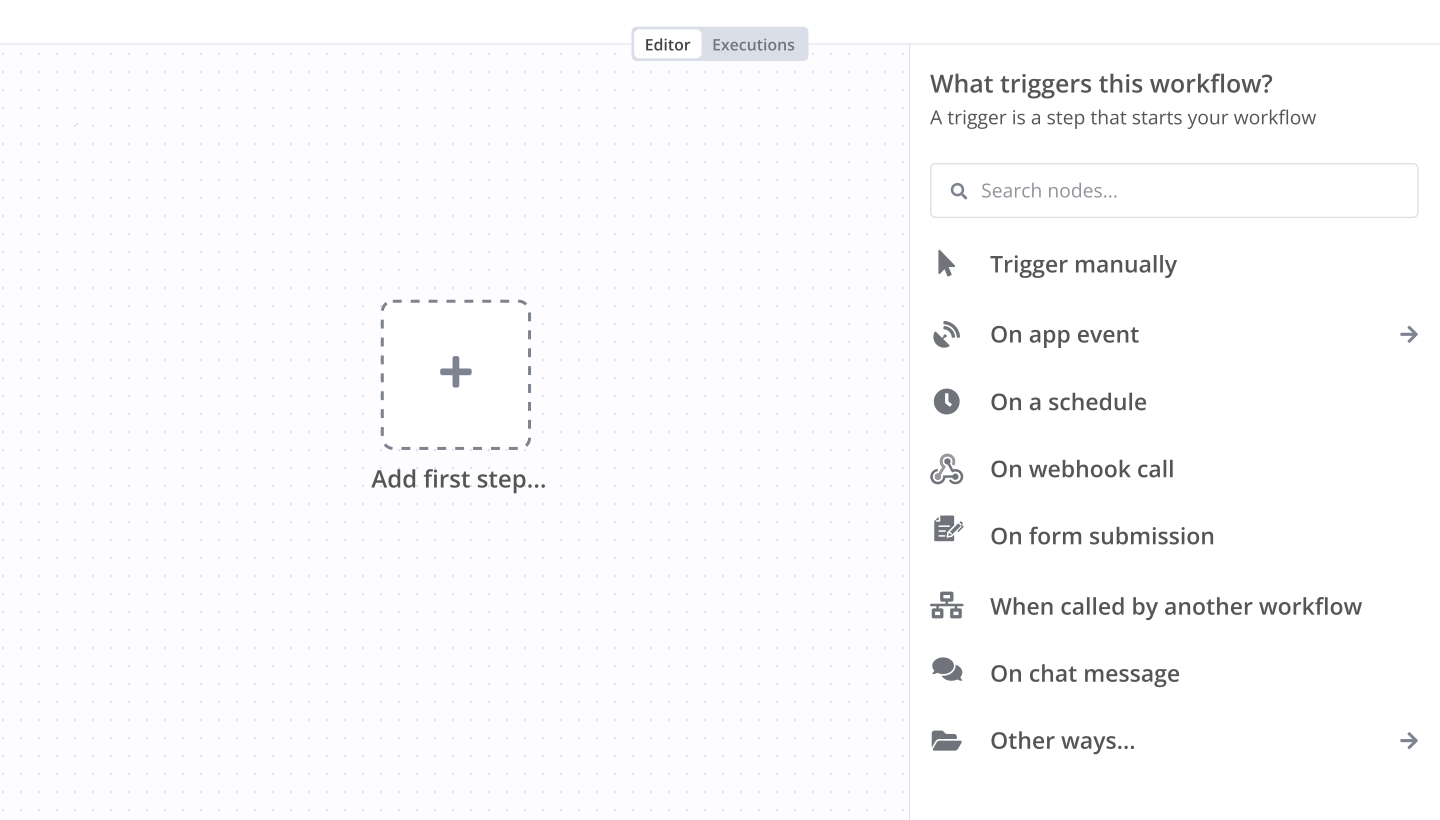
Salesforce and Slack integration: Create a new workflow and add the first step

Step 2: Add and configure Salesforce and Slack nodes

You can find Salesforce and Slack in the nodes panel. Drag them onto your workflow canvas, selecting their actions. Click each node, choose a credential, and authenticate to grant n8n access. Configure Salesforce and Slack nodes one by one: input data on the left, parameters in the middle, and output data on the right.

Salesforce and Slack integration: Add and configure Salesforce and Slack nodes

Step 3: Connect Salesforce and Slack

A connection establishes a link between Salesforce and Slack (or vice versa) to route data through the workflow. Data flows from the output of one node to the input of another. You can have single or multiple connections for each node.

Salesforce and Slack integration: Connect Salesforce and Slack

Step 4: Customize and extend your Salesforce and Slack integration

Use n8n's core nodes such as If, Split Out, Merge, and others to transform and manipulate data. Write custom JavaScript or Python in the Code node and run it as a step in your workflow. Connect Salesforce and Slack with any of n8n’s 1000+ integrations, and incorporate advanced AI logic into your workflows.

Salesforce and Slack integration: Customize and extend your Salesforce and Slack integration

Step 5: Test and activate your Salesforce and Slack workflow

Save and run the workflow to see if everything works as expected. Based on your configuration, data should flow from Salesforce to Slack or vice versa. Easily debug your workflow: you can check past executions to isolate and fix the mistake. Once you've tested everything, make sure to save your workflow and activate it.

Salesforce and Slack integration: Test and activate your Salesforce and Slack workflow

AI-powered lead scoring with Salesforce, GPT-4o, and Slack with data masking

Boost your sales team’s efficiency with an end-to-end, privacy-first lead-scoring engine—ready to drop straight into your n8n instance.

🔹 What it does

Salesforce Trigger watches for new or updated Leads every hour.

HTTP Request fetches the full record so you never miss a field.

Mask Data (JS Code) automatically tokenises PII (name, email, address, etc.) before any external call—ideal for GDPR/SOC 2 compliance.

OpenAI (GPT-4o) scores each lead 0-100, assigns a grade A-F, lists key reasons, recommends one next action, and even drafts a personalised email template.

Unmask Data (JS Code) swaps the tokens back in only when you explicitly need them—so sensitive data never leaks to logs or AI prompts.

Slack Node delivers a concise, team-friendly summary (score, grade, reasons, next step, and draft email) right to the rep who needs it.

🔹 Why you’ll love it

Security by design – field-level masking with reversible tokens.

No-code friendly – clear sticky notes explain every step; swap Salesforce for any CRM in minutes.

AI you can trust – scoring rubric baked into the system prompt for consistent results.

Instant hand-off – reps get an actionable Slack message instead of another spreadsheet.

Perfect for rev-ops teams that want smarter prioritisation without rebuilding their stack—or exposing customer data. Plug it in, set your own masking list, and start converting the leads that matter most.

Nodes used in this workflow

Popular Salesforce and Slack workflows

Automate Stale Deal Follow-Ups in Salesforce with GPT-5.1, Email, Slack & Tasks

How it works Runs every morning at 8:00 using the Schedule Trigger. Sets a stale_days value and queries Salesforce for Opportunities where Stage_Unchanged_Days__c equals that value and the stage is not Closed Won / Closed Lost. For each “stale” Opportunity, loads full deal details and sends them to an OpenAI model. The model uses the query_soql tool to pull recent Notes, the primary Contact, and the Opportunity Owner, then returns a single JSON object with: a personalized follow-up email for the client, a short SMS template, a concise Slack summary for the sales team, and a ready-to-use Task payload for Salesforce. n8n parses that JSON, sends the email via SMTP, posts the Slack message to your chosen channel, and creates a Salesforce Task assigned to the Opportunity Owner so every stalled deal has a clear next step. Setup steps Estimated setup time: ~30–45 minutes if your Salesforce, OpenAI, SMTP and Slack credentials are ready. Create Stage_Unchanged_Days__c on Opportunity (Salesforce) Field Type: Formula (Number, 0 decimal places) Formula: IF( ISBLANK(LastStageChangeDate), TODAY() - DATEVALUE(CreatedDate), TODAY() - DATEVALUE(LastStageChangeDate) ) This field tracks how many days the Opportunity has been in the current stage. Connect credentials in n8n Salesforce OAuth2 for the Salesforce nodes and the query_soql HTTP Tool. OpenAI (or compatible) credential for the “Message a model” node. SMTP credential for the customer email node. Slack credential for the internal notification node. Configure your follow-up rules In Edit Fields (Set), set stale_days to the threshold that defines a stalled deal (e.g. 7, 14, 30). In Perform a query, optionally refine the SOQL (record types, owners, minimum amount, etc.) to match your pipeline. Update the Send Email SMTP Customer node with your real “from” address and tweak the wording if needed. Point Send Message To Internal Team (Slack) to the right channel or user. Test safely Turn off the Schedule Trigger and run the workflow manually with a few test Opportunities. Inspect the AI output in Message a model and Parse JSON to confirm the structure (email, sms, slack, task.api_body). Check that the email and Slack messages look good and that Salesforce Tasks are created, assigned to the right Owner, and linked to the correct Opportunity. Go live Re-enable the Schedule Trigger. Monitor the first few days to confirm that follow-ups, Slack alerts, and Tasks all behave as expected, then let the automation quietly keep your pipeline clean and moving.
+5

Automate B2B SaaS Renewal Risk Management with CRM, Support & Usage Data

Description This workflow is designed for B2B/SaaS teams who want to secure renewals before it’s too late. It runs every day, identifies all accounts whose licenses are up for renewal in J–30, enriches them with CRM, product usage and support data, computes an internal churn risk level, and then triggers the appropriate playbook: HIGH risk** → full escalation (tasks, alerts, emails) MEDIUM risk** → proactive follow-up by Customer Success LOW risk** → light renewal touchpoint / monitoring Everything is logged into a database table so that you can build dashboards, run analysis, or plug additional automations on top. How it works Daily detection (J–30 renewals) A scheduled trigger runs every morning and queries your database (Postgres / Supabase) to fetch all active subscriptions expiring in 30 days. Each row includes the account identifier, name, renewal date and basic commercial data. Data enrichment across tools For each account, the workflow calls several business systems to collect context: HubSpot → engagement history Salesforce → account profile and segment Pipedrive → deal activities and associated products Analytics API → product feature usage and activity trends Zendesk → recent support tickets and potential friction signals All of this is merged into a single, unified item. Churn scoring & routing An internal scoring step evaluates the risk for each account based on multiple signals (engagement, usage, support, timing). The workflow then categorizes each account into one of three risk levels: HIGH – strong churn signals → needs immediate attention MEDIUM – some warning signs → needs proactive follow-up LOW – looks healthy → light renewal reminder A Switch node routes each account to the relevant playbook. Automated playbooks 🔴 HIGH risk Create a Trello card on a dedicated “High-Risk Renewals” board/list Create a Jira ticket for the CS / AM team Send a Slack alert in a designated channel Send a detailed email to the CSM and/or account manager 🟠 MEDIUM risk Create a Trello card in a “Renewals – Follow-up” list Send a contextual email to the CSM to recommend a proactive check-in 🟢 LOW risk Send a soft renewal email / internal note to keep the account on the radar Logging & daily reporting For every processed account, the workflow prepares a structured log record (account, renewal date, risk level, basic context). A Postgres node is used to insert the data into a churn_logs table. At the end of each run, all processed accounts are aggregated and a daily summary email is sent (for example to the Customer Success leadership team), listing the renewals and their risk levels. Requirements Database A table named churn_logs (or equivalent) to store workflow decisions and history. Example fields: account_id, account_name, end_date, riskScore, riskLevel, playbook, trello_link, jira_link, timestamp. External APIs HubSpot (engagement data) Salesforce (account profile) Pipedrive (deals & products) Zendesk (support tickets) Optional: product analytics API for usage metrics Communication & task tools Gmail (emails to CSM / AM / summary recipients) Slack (alert channel for high-risk cases) Trello (task creation for CS follow-up) Jira (escalation tickets for high-risk renewals) Configuration variables Thresholds are configured in the Init config & thresholds node: days_before_renewal churn_threshold_high churn_threshold_medium These parameters let you adapt the detection window and risk sensitivity to your own business rules. Typical use cases Customer Success teams who want a daily churn watchlist without exporting spreadsheets. RevOps teams looking to standardize renewal playbooks across tools. SaaS companies who need to prioritize renewals based on real risk signals rather than gut feeling. Product-led organizations that want to combine usage data + CRM + support into one automated process. Tutorial video Watch the Youtube Tutorial video About me : I’m Yassin a Project & Product Manager Scaling tech products with data-driven project management. 📬 Feel free to connect with me on Linkedin

Salesforce to S3 File Migration & Cleanup

Salesforce to S3 File Migration & Cleanup Automate archiving old Salesforce files to Amazon S3, log them back in Salesforce, and free up org storage — all from a scheduled n8n workflow. 🔧 How It Works (High-Level) Schedule Trigger kicks off (e.g., daily). Query Salesforce for ContentDocument records older than 365 days. Loop Each File → download binary via REST. Upload to S3 with the original filename. Lookup Links (ContentDocumentLink) to keep the parent record reference. Filter Out Users (ignore LinkedEntityId starting with 005). Create S3_File__c record in Salesforce for traceability. Delete Original File from Salesforce to reclaim storage. Notify via Slack when the batch is done. 🚀 Set Up Steps (Time: ~45–90 mins) Import n8n Workflow JSON and wire up credentials (Salesforce OAuth2, AWS S3, Slack). Install Salesforce Unmanaged Package (Custom Object S3_File__c, Apex controller, LWC, settings). Fill S3Settings__c (bucket, region, keys, expiry) or swap to Named Credentials. Test with a Sandbox Batch (e.g., small date range) and verify upload/delete. Schedule & Monitor (tweak interval, Slack channel). 💖 Why you’ll love it 💸 Slash storage costs — offload gigabytes to S3 🔍 Full traceability — every file still tracked in Salesforce 🧰 Plug & play — import JSON, install package, plug in creds 🧱 Modular & extensible — swap S3, add approvals, build an uploader UI ⏱ Set it & forget it — scheduled automation + Slack alerts 📦 What’s Included n8n JSON Flow** – ready to import. Salesforce Unmanaged Package** – Apex (S3FilesController.cls), LWC (s3FilesViewer), S3_File__c, S3Settings__c. S3 + Salesforce Setup Guide** – quick reference for configuring keys, permissions, and the LWC. All components are editable — extend, replace, or integrate with your own processes. 🧱 Requirements n8n instance (self-hosted or Cloud) with HTTP Request, AWS S3, Slack, and Salesforce nodes. Salesforce org with API access & permission to install unmanaged packages. You have to have Query All Files permission. Setup-> Permission Sets / Profile -> App Permission -> Content -> Query All Files. Allows View All Data users to SOQL query all files in the org. AWS S3 bucket + IAM user/role with GetObject/PutObject (and optional ListBucket).

AI-Powered Lead Scoring with Salesforce, GPT-4o, and Slack with Data Masking

Boost your sales team’s efficiency with an end-to-end, privacy-first lead-scoring engine—ready to drop straight into your n8n instance. 🔹 What it does Salesforce Trigger watches for new or updated Leads every hour. HTTP Request fetches the full record so you never miss a field. Mask Data (JS Code) automatically tokenises PII (name, email, address, etc.) before any external call—ideal for GDPR/SOC 2 compliance. OpenAI (GPT-4o) scores each lead 0-100, assigns a grade A-F, lists key reasons, recommends one next action, and even drafts a personalised email template. Unmask Data (JS Code) swaps the tokens back in only when you explicitly need them—so sensitive data never leaks to logs or AI prompts. Slack Node delivers a concise, team-friendly summary (score, grade, reasons, next step, and draft email) right to the rep who needs it. 🔹 Why you’ll love it Security by design – field-level masking with reversible tokens. No-code friendly – clear sticky notes explain every step; swap Salesforce for any CRM in minutes. AI you can trust – scoring rubric baked into the system prompt for consistent results. Instant hand-off – reps get an actionable Slack message instead of another spreadsheet. Perfect for rev-ops teams that want smarter prioritisation without rebuilding their stack—or exposing customer data. Plug it in, set your own masking list, and start converting the leads that matter most.
+3

Generate RFP proposal drafts from Google Drive with Groq AI, Salesforce and Slack

RFP Automation Workflow with Google Drive, Groq AI (LLaMA 3), Salesforce & Slack > Automate Your Entire RFP Lifecycle This workflow automatically detects new RFP documents uploaded to Google Drive, extracts key requirements using Groq AI (LLaMA 3), generates a complete proposal draft, stores it in Google Docs, creates a Salesforce opportunity, assigns a review task and notifies your team via Slack. Quick Implementation Steps Connect your Google Drive, Groq API, Salesforce, Google Docs and Slack accounts in n8n Set your RFP Intake Folder ID in the trigger node Set a separate Knowledge Base folder for past proposals Customize your company profile in the AI proposal generator node Activate the workflow Upload an RFP → Everything runs automatically What It Does This workflow fully automates the end-to-end process of handling RFP (Request for Proposal) documents. When a new file is uploaded to a specific Google Drive folder, the workflow immediately triggers and downloads the document. It then extracts text from the file and prepares structured metadata such as file name, URL and timestamp. Using Groq-powered AI (LLaMA 3), the workflow analyzes the document and converts unstructured RFP content into structured JSON data. This includes critical fields like client name, project scope, deadlines, budget, technical requirements and evaluation criteria. The workflow ensures that even imperfect AI outputs are safely parsed and normalized. Next, the workflow enhances proposal quality by referencing past proposals stored in a separate knowledge base folder. It then generates a complete, professional proposal draft tailored to the extracted requirements. Finally, it stores outputs in Google Docs and Salesforce, assigns a review task and notifies the team via Slack—ensuring no RFP is missed and every response is standardized. Who It's For IT services companies handling frequent RFP submissions Consulting firms responding to client proposals Digital agencies managing multiple bids Sales and business development teams Enterprises looking to standardize proposal creation Requirements To use this workflow, you need: n8n account (self-hosted or cloud) Google Drive account** RFP Intake Folder Knowledge Base Folder (past proposals) Groq API Key** Salesforce account** Opportunity + Task access Google Docs account** Slack workspace** How It Works & Set Up Step 1: Google Drive Trigger Setup Configure Watch RFP Upload Folder node Replace with your RFP Intake Folder ID Trigger: fileCreated Step 2: File Processing The workflow: Downloads the uploaded file Extracts text (PDF supported) Prepares metadata (file name, ID, URL, timestamp) Step 3: AI Requirement Extraction Configure Groq API credentials Model used: llama-3.3-70b-versatile Extracts structured data such as: Client name Project scope Budget & deadlines Technical requirements Step 4: Clean & Parse Output Code node ensures: JSON is valid Markdown artifacts are removed Fallback structure is used if parsing fails Step 5: Knowledge Base Integration Configure Fetch Past Proposals (KB) node Replace with your separate Knowledge Base folder ID Fetches previous proposal documents for reference Step 6: AI Proposal Generation Uses extracted requirements + KB context Generates a full proposal with sections: Executive Summary Solution Timeline Pricing Team Customize company details inside prompt Step 7: Output Storage Saves proposal to Google Docs Creates Salesforce Opportunity with: Name Deadline Value Description Step 8: Task Creation & Notification Creates a Salesforce Task for review Sends notification to Slack channel How To Customize Nodes AI Nodes Change model (e.g., Mixtral, LLaMA variants) Adjust temperature: 0.1 → structured extraction 0.7 → creative writing Proposal Generator Update: Company name Services Strengths Modify proposal sections if needed Salesforce Node Map custom fields (e.g., Industry__c) Adjust stage names or pipeline stages Slack Node Change channel (#general) Customize notification message Add-Ons You can extend this workflow with: Email notifications (Gmail/Outlook) Approval workflows before submission PDF export of proposal CRM enrichment (HubSpot, Zoho) AI scoring for win probability Auto-deadline reminders Use Case Examples Automatically respond to government RFPs IT companies generating proposals for software projects Agencies handling multiple client bids daily Consulting firms standardizing proposal quality Sales teams tracking opportunities with zero manual entry There can be many more use cases depending on your business workflow and automation needs. Troubleshooting Guide | Issue | Possible Cause | Solution | |------|--------------|---------| | Workflow not triggering | Incorrect folder ID | Verify Google Drive folder ID | | No text extracted | Unsupported file format | Use PDF format | | AI output parsing fails | Unexpected AI response | Check logs in "Clean & Parse AI Output" node | | Salesforce error | Missing custom fields | Remove or create fields in Salesforce | | Proposal not saved | Google Docs credentials issue | Reconnect Google Docs API | | Slack message not sent | Wrong channel or credentials | Verify Slack integration | Need Help? If you need help setting up, customizing or scaling this workflow, our n8n workflow development team at WeblineIndia is happy to help. We can help you: Customize AI prompts for your business Integrate additional CRMs or tools Build advanced automation pipelines Optimize proposal quality using AI Reach out to WeblineIndia for expert support and tailored automation solutions.
+2

Compare proposals and analyze gaps for Salesforce CRM with Groq AI

AI Proposal Comparison & Gap Analysis Workflow for Salesforce CRM This workflow automatically analyzes newly uploaded proposals by comparing them with past winning proposals using AI. It extracts proposal content, identifies the client, fetches reference data from Google Sheets and generates actionable insights. These insights are saved in Salesforce and shared on Slack for team visibility. Quick Implementation Steps Connect Google Drive, Google Sheets, Salesforce, Slack and Groq AI credentials in your n8n account. Set your Google Drive folder to monitor proposal uploads. Ensure your Google Sheet contains winning proposals with status = Won. Activate the workflow. Upload a proposal file to trigger analysis automatically. What It Does This workflow automates the process of analyzing business proposals by leveraging AI and historical data. When a new proposal file is uploaded to a specific Google Drive folder, the workflow downloads and extracts its content. It then identifies the client name using a simple pattern from the text. At the same time, the workflow fetches past winning proposals from a Google Sheets database filtered by status. Both the current and past proposals are combined and sent to an AI model for comparison. The AI generates concise insights highlighting missing elements, weak positioning, pricing gaps and improvement suggestions. Finally, the insights are formatted and stored in Salesforce as an Opportunity record. A notification is sent to Slack, ensuring the team is informed and can act quickly to improve proposal quality. Who It's For Sales teams managing multiple proposals Business development professionals Proposal review and strategy teams Organizations using Salesforce CRM Teams looking to improve win rates using AI Requirements n8n account (self-hosted or cloud) Google Drive account (with folder for proposals) Google Sheets account (with winning proposals data) Salesforce account (Opportunity access enabled) Slack workspace (channel for notifications) Groq API credentials (for AI model access) How It Works & Set Up Setup Google Drive Trigger Configure New Proposal Upload Trigger Select the folder where proposals will be uploaded Event: fileCreated Download and Extract Proposal Use Download Proposal node to fetch file Use Read Proposal Text node to extract content Extract Client Information Use Extract Client Info (Code node) Extract clientName using regex from text Store full proposal as currentProposal Fetch Winning Proposals Configure Get Winning Proposal Data (Knowledge Base) Connect Google Sheet Filter where status = Won Combine Data Use Combine Proposal Data (Merge node) Combine current proposal and past proposal AI Analysis Use AI Proposal Gap Analyzer Provide prompt to compare proposals Generate structured insights (8–10 bullet points) Format Output Use Format Analysis Output Map clientName and analysisSummary Save to Salesforce Use Save Insights to Salesforce Create Opportunity Add insights in description Prepare Final Output Use Prepare Final Output (Merge node) Add Delay (Optional Control) Use Wait for Save node (2 seconds delay) Send Slack Notification Use Send Notification to Slack Send formatted message with insights How To Customize Nodes Extract Client Info:** Modify regex if proposal format changes Google Sheets Node:** Change filter or add more columns AI Prompt:** Customize output format or analysis depth Salesforce Node:** Change stage, fields or object type Slack Node:** Update message format or channel Wait Node:** Adjust delay time if needed Add-ons Add email notification (Gmail node) Store results in Google Sheets for history Add error handling with IF node Add multiple proposal comparison logic Integrate dashboard (Notion, Airtable, etc.) Use Case Examples Improving proposal quality before client submission Training new sales team members using past wins Automating proposal review workflows Identifying common gaps in losing proposals Tracking proposal insights in CRM There can be many more use cases depending on how you extend this workflow. Troubleshooting Guide | Issue | Possible Cause | Solution | | --------------------------- | ------------------------------ | ----------------------------------------- | | No trigger on file upload | Incorrect folder selected | Verify Google Drive folder ID | | Client name not extracted | Proposal format mismatch | Update regex in Code node | | No data from Google Sheets | Filter mismatch (status = Won) | Check column name and values | | AI output empty | Prompt or input missing | Verify merged data structure | | Salesforce error | Invalid credentials or field | Check API credentials and field mapping | | Slack message not sent | Wrong channel or auth issue | Reconnect Slack credentials | | Workflow stops before Slack | Wait node misconfigured | Ensure correct connection after Wait node | Need Help? If you need assistance setting up this workflow, customizing nodes or adding advanced features, we’re here to help. Whether it's integrating additional tools, improving AI analysis or building custom automation workflows tailored to your business needs, feel free to reach out to our n8n developers at WeblineIndia. Get expert help to scale your automation and build powerful AI-driven workflows efficiently.

Build your own Salesforce and Slack integration

Create custom Salesforce and Slack workflows by choosing triggers and actions. Nodes come with global operations and settings, as well as app-specific parameters that can be configured. You can also use the HTTP Request node to query data from any app or service with a REST API.

Salesforce supported actions

Add Note
Add note to an account
Create
Create an account
Create or Update
Create a new account, or update the current one if it already exists (upsert)
Delete
Delete an account
Get
Get an account
Get Many
Get many accounts
Get Summary
Returns an overview of account's metadata
Update
Update an account
Create
Create a attachment
Delete
Delete a attachment
Get
Get a attachment
Get Many
Get many attachments
Get Summary
Returns an overview of attachment's metadata
Update
Update a attachment
Add Comment
Add a comment to a case
Create
Create a case
Delete
Delete a case
Get
Get a case
Get Many
Get many cases
Get Summary
Returns an overview of case's metadata
Update
Update a case
Add Contact To Campaign
Add contact to a campaign
Add Note
Add note to a contact
Create
Create a contact
Create or Update
Create a new contact, or update the current one if it already exists (upsert)
Delete
Delete a contact
Get
Get a contact
Get Many
Get many contacts
Get Summary
Returns an overview of contact's metadata
Update
Update a contact
Create
Create a custom object record
Create or Update
Create a new record, or update the current one if it already exists (upsert)
Delete
Delete a custom object record
Get
Get a custom object record
Get Many
Get many custom object records
Update
Update a custom object record
Upload
Upload a document
Get Many
Get many flows
Invoke
Invoke a flow
Add Lead To Campaign
Add lead to a campaign
Add Note
Add note to a lead
Create
Create a lead
Create or Update
Create a new lead, or update the current one if it already exists (upsert)
Delete
Delete a lead
Get
Get a lead
Get Many
Get many leads
Get Summary
Returns an overview of Lead's metadata
Update
Update a lead
Add Note
Add note to an opportunity
Create
Create an opportunity
Create or Update
Create a new opportunity, or update the current one if it already exists (upsert)
Delete
Delete an opportunity
Get
Get an opportunity
Get Many
Get many opportunities
Get Summary
Returns an overview of opportunity's metadata
Update
Update an opportunity
Query
Execute a SOQL query that returns all the results in a single response
Create
Create a task
Delete
Delete a task
Get
Get a task
Get Many
Get many tasks
Get Summary
Returns an overview of task's metadata
Update
Update a task
Get
Get a user
Get Many
Get many users

Slack supported actions

Archive
Archives a conversation
Close
Closes a direct message or multi-person direct message
Create
Initiates a public or private channel-based conversation
Get
Get information about a channel
Get Many
Get many channels in a Slack team
History
Get a conversation's history of messages and events
Invite
Invite a user to a channel
Join
Joins an existing conversation
Kick
Removes a user from a channel
Leave
Leaves a conversation
Member
List members of a conversation
Open
Opens or resumes a direct message or multi-person direct message
Rename
Renames a conversation
Replies
Get a thread of messages posted to a channel
Set Purpose
Sets the purpose for a conversation
Set Topic
Sets the topic for a conversation
Unarchive
Unarchives a conversation
Get
Get Many
Get & filters team files
Upload
Create or upload an existing file
Delete
Get Permalink
Search
Send
Send and Wait for Response
Update
Add
Adds a reaction to a message
Get
Get the reactions of a message
Remove
Remove a reaction of a message
Add
Add a star to an item
Delete
Delete a star from an item
Get Many
Get many stars of autenticated user
Get
Get information about a user
Get Many
Get a list of many users
Get User's Profile
Get a user's profile
Get User's Status
Get online status of a user
Update User's Profile
Update a user's profile
Add Users
Create
Disable
Enable
Get Many
Get Users
Update

FAQs

  • Can Salesforce connect with Slack?

  • Can I use Salesforce’s API with n8n?

  • Can I use Slack’s API with n8n?

  • Is n8n secure for integrating Salesforce and Slack?

  • How to get started with Salesforce and Slack integration in n8n.io?

Need help setting up your Salesforce and Slack integration?

Discover our latest community's recommendations and join the discussions about Salesforce and Slack integration.
Nicolas N
Muhammed Iqbal P B
Nicolas N

Looking to integrate Salesforce and Slack in your company?

Over 3000 companies switch to n8n every single week

Why use n8n to integrate Salesforce with Slack

Build complex workflows, really fast

Build complex workflows, really fast

Handle branching, merging and iteration easily.
Pause your workflow to wait for external events.

Code when you need it, UI when you don't

Simple debugging

Your data is displayed alongside your settings, making edge cases easy to track down.

Use templates to get started fast

Use 1000+ workflow templates available from our core team and our community.

Reuse your work

Copy and paste, easily import and export workflows.

Implement complex processes faster with n8n

red iconyellow iconred iconyellow icon